

Another way to say detail oriented is meticulous, thorough, attentive to detail, precise, or highly organized. These alternatives help you describe your ability to spot errors, follow instructions, and produce accurate work. Choose a phrase that fits your experience and the situation, especially when writing a resume, cover letter, or professional email.
Key Takeaways
- Use meticulous or precise to highlight accuracy and careful work.
- Choose thorough when you want to emphasize completeness.
- Use organized or methodical to describe a structured approach to tasks.
- Select attentive to detail for a clear, professional alternative.
- Support your chosen phrase with a real example of your skills or achievements.
Being detail-oriented means paying close attention to small but important parts of a task. Whether you are updating your resume, writing a cover letter, or describing your work habits, choosing the right words can help you communicate this strength more clearly.
The best alternative depends on what you want to emphasize. Some phrases highlight accuracy, while others show organization, careful planning, or the ability to catch mistakes before they become problems.
What Does “Detail-Oriented” Mean?
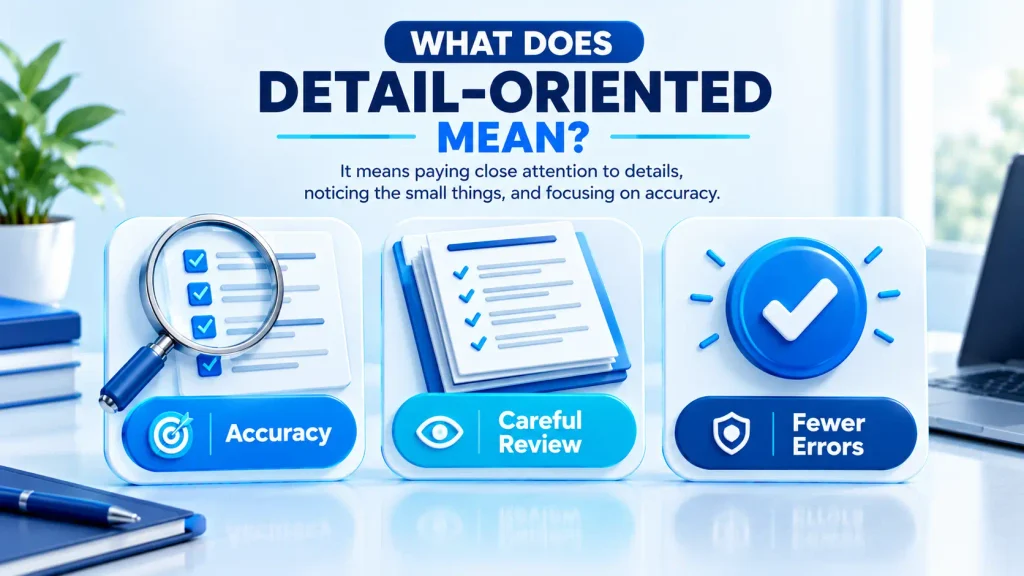
Detail-oriented describes someone who pays close attention to the small parts of a task and works to ensure everything is correct. A detail-oriented person may notice errors, follow instructions carefully, check facts, and review work before submitting it.
People commonly use this term in resumes, job descriptions, performance reviews, and professional conversations. Employers often value this quality because it can help improve accuracy, reduce mistakes, and maintain consistent work standards.
For example, an accountant who checks financial records for errors or an editor who catches spelling mistakes demonstrates attention to detail.
Why Use Other Ways to Say “Detail-Oriented”?
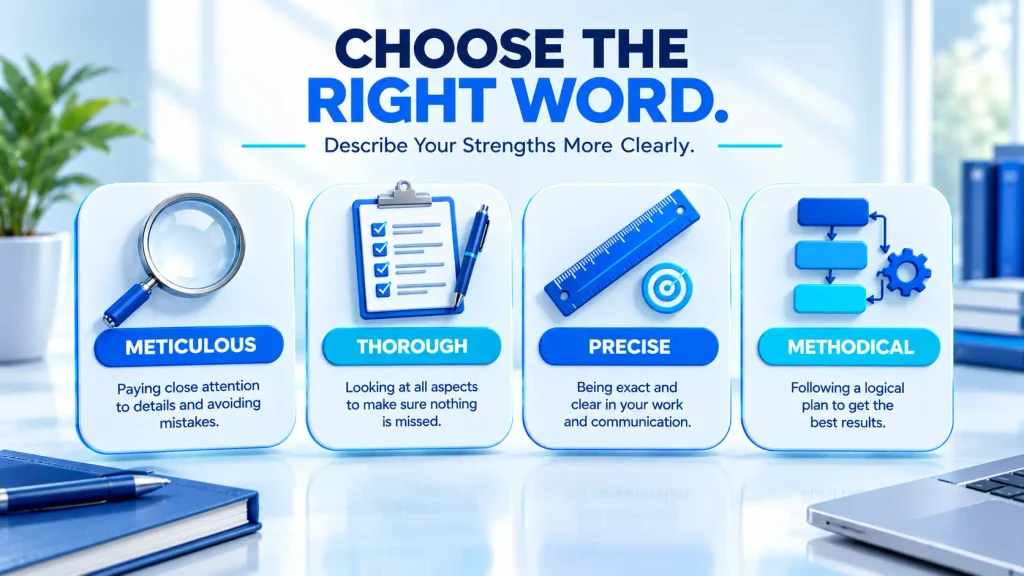
Although detail-oriented is a useful expression, repeating it can make your writing sound generic. A more specific alternative can show employers and colleagues exactly how you approach your work.
Consider using another phrase when you want to:
- Avoid repetition: Keep your resume and cover letter from sounding repetitive.
- Highlight a specific strength: Emphasize accuracy, organization, or careful analysis.
- Sound more natural: Choose language that fits the situation.
- Improve professional communication: Describe your working style clearly.
- Show practical value: Connect your attention to detail with real results.
The key is to choose wording that reflects your actual skills rather than simply replacing one common expression with another.
10 Best Other Ways to Say “Detail-Oriented”

1. Meticulous
Meaning
Meticulous describes someone who pays very close attention to details and takes care to get things right. It suggests a high level of precision and a strong commitment to quality.
This is an effective alternative when your work requires careful checking, exact measurements, or close review.
Best For
Professional, Formal
Example 1
- “I take a meticulous approach to reviewing financial reports before submission.”
Example 2
- “Her meticulous recordkeeping helped the team resolve several billing discrepancies.”
Quick Tip
Use meticulous when you want to emphasize exceptional care and accuracy. It works well in professional summaries, performance reviews, and cover letters.
2. Thorough
Meaning
Thorough describes someone who examines a task carefully and covers all the necessary details. It emphasizes completeness rather than just precision.
This phrase works especially well when you want to show that you do not overlook important steps or leave work unfinished.
Best For
Professional, Formal, Polite
Example 1
- “I conduct thorough reviews of project documents before sending them to clients.”
Example 2
- “Her thorough research helped us identify the cause of the recurring issue.”
Quick Tip
Choose thorough when the task involves research, reviewing documents, testing processes, or completing a detailed assessment.
3. Attentive to Detail
Meaning
Attentive to detail is a direct, natural alternative to detail-oriented. It describes someone who notices small differences, checks important information, and takes care with their work.
Because it is easy to understand, this expression fits many industries and professional settings.
Best For
Professional, Formal, Friendly
Example 1
- “I am attentive to detail when preparing customer invoices and updating account records.”
Example 2
- “We need an editor who is attentive to detail and consistent with style guidelines.”
Quick Tip
Use this phrase when you want a straightforward replacement that preserves the original meaning without sounding overly formal.
4. Precise
Meaning
Precise describes work that is accurate, exact, and clearly defined. It is especially useful when small errors can affect the quality or reliability of a result.
This word focuses on correctness and exactness rather than the broader habit of checking every detail.
Best For
Professional, Formal
Example 1
- “I use precise calculations to verify monthly budget projections.”
Example 2
- “The technician followed precise instructions when calibrating the equipment.”
Quick Tip
Choose precise for roles involving data, measurements, technical work, editing, or financial accuracy.
5. Highly Organized
Meaning
Highly organized describes someone who arranges information, manages responsibilities, and keeps tasks on track. It can suggest attention to detail because good organization often depends on tracking deadlines, records, and small requirements.
However, organization and attention to detail are different skills, so use this expression when both are relevant to your experience.
Best For
Professional, Friendly
Example 1
- “I am highly organized and maintain accurate records for multiple ongoing projects.”
Example 2
- “Our highly organized coordinator keeps schedules, contracts, and meeting notes up to date.”
Quick Tip
Use highly organized when you want to highlight planning, time management, recordkeeping, or the ability to manage several responsibilities at once.
6. Methodical
Meaning
Methodical describes someone who follows a logical, organized process instead of rushing through a task. It emphasizes consistency, structure, and a step-by-step approach.
A methodical person often uses checklists, established procedures, or repeatable systems to maintain quality.
Best For
Professional, Formal
Example 1
- “I take a methodical approach to troubleshooting technical problems.”
Example 2
- “Her methodical review process helps ensure that every application meets the required standards.”
Quick Tip
Choose methodical when you want to show that your accuracy comes from a reliable process rather than simply being careful.
7. Careful and Accurate
Meaning
Careful and accurate describes someone who works thoughtfully and produces correct results. It is a clear alternative that communicates both attention during a task and the quality of the final outcome.
The expression is easy to understand and does not rely on business jargon.
Best For
Professional, Polite, Friendly
Example 1
- “I am careful and accurate when entering patient information into electronic records.”
Example 2
- “The team needs someone who can prepare careful and accurate inventory reports.”
Quick Tip
Use this phrase when clarity matters more than sophisticated wording, particularly in applications for administrative, clerical, and recordkeeping positions.
8. Diligent
Meaning
Diligent describes someone who puts consistent effort into their responsibilities and completes work with care. It suggests reliability, persistence, and a strong sense of responsibility.
Although diligence includes attention to detail, it also emphasizes effort and follow-through.
Best For
Professional, Formal, Warm
Example 1
- “I am diligent about checking project requirements before finalizing deliverables.”
Example 2
- “His diligent follow-up ensured that every outstanding customer request received a response.”
Quick Tip
Choose diligent when you want to communicate a strong work ethic alongside careful, dependable performance.
9. Observant
Meaning
Observant describes someone who notices details, changes, or patterns that other people might miss. It is especially useful when attention involves watching for inconsistencies or recognizing useful information.
Unlike meticulous, which emphasizes careful execution, observant focuses more on noticing what is happening.
Best For
Professional, Casual, Friendly
Example 1
- “As an observant quality inspector, I can identify product defects before packaging.”
Example 2
- “Her observant approach helped the support team recognize a recurring customer concern.”
Quick Tip
Use observant when the ability to notice changes, spot problems, or recognize patterns is central to the role.
10. Exacting
Meaning
Exacting describes someone who expects a high standard of accuracy and quality. It can suggest careful work and strong attention to requirements, particularly in demanding professional environments.
The word may also imply that a person or task has strict standards, so use it thoughtfully.
Best For
Formal, Professional
Example 1
- “The role requires an exacting approach to reviewing legal documents.”
Example 2
- “She maintains exacting quality standards when preparing technical specifications.”
Quick Tip
Choose exacting for specialized or high-precision work. For everyday resumes, thorough or attentive to detail may sound more natural.
Comparison Table
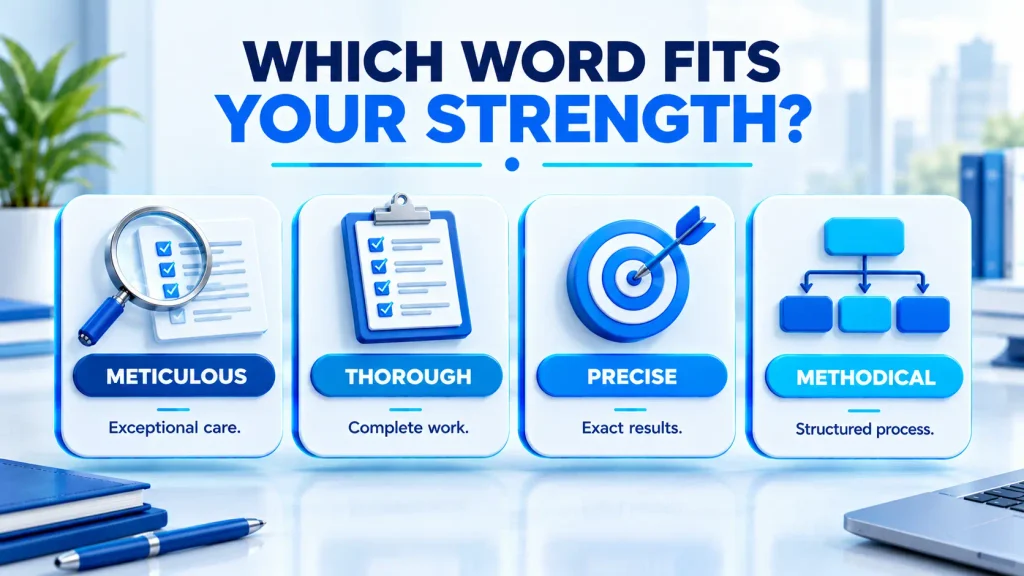
| Alternative | Best Used In | Tone |
|---|---|---|
| Meticulous | Quality control, editing, finance | Professional, precise |
| Thorough | Research, reviews, assessments | Clear, professional |
| Attentive to detail | Resumes, cover letters, emails | Natural, professional |
| Precise | Technical, scientific, financial work | Exact, formal |
| Highly organized | Administration, coordination, project work | Practical, professional |
| Methodical | Analysis, troubleshooting, process management | Structured, professional |
| Careful and accurate | Data entry, records, administrative tasks | Direct, clear |
| Diligent | General work performance, follow-up | Dependable, professional |
| Observant | Inspection, customer service, problem detection | Perceptive, approachable |
| Exacting | Technical standards, legal or quality reviews | Formal, demanding |
Common Mistakes When Describing Attention to Detail

1. Using the Same Phrase Repeatedly
Repeating detail-oriented in your resume summary, skills section, and cover letter can make your application sound generic.
Better approach: Vary your wording according to the skill you want to highlight. Use meticulous for accuracy and methodical for a structured process.
2. Choosing an Alternative That Does Not Fit
Not every synonym means exactly the same thing. For example, being organized is not identical to being precise, and being diligent does not automatically mean that your work is error-free.
Better approach: Select a phrase that accurately reflects your strengths and the requirements of the role.
3. Relying on Buzzwords
Words such as meticulous and exacting can sound impressive, but they may not convince an employer on their own.
Better approach: Add a specific achievement or responsibility that demonstrates your attention to detail.
4. Making Unsupported Claims
Calling yourself exceptionally accurate without evidence can weaken your credibility.
Better approach: Describe something you actually do, such as reconciling records, reviewing reports, or identifying inconsistencies before submission.
5. Using Overly Formal Language
An elaborate word may sound unnatural in a casual email or an entry-level resume.
Better approach: Use clear phrases such as attentive to detail or careful and accurate when they communicate your point more effectively.
Frequently Asked Questions
1. What is another way to say detail-oriented?
Common alternatives include meticulous, thorough, precise, attentive to detail, methodical, and diligent. The best choice depends on what you want to emphasize. Use meticulous for careful work, precise for exact results, and methodical for a structured approach to completing tasks.
2. What is the best synonym for detail-oriented on a resume?
Attentive to detail is one of the clearest alternatives for a resume because it communicates the skill directly. Meticulous is useful for roles that demand high accuracy, while methodical works well when a position requires structured processes. Choose the phrase that matches the job description and your actual experience.
3. How do you describe attention to detail professionally?
Describe the specific actions you take to maintain accuracy. For example, you might explain that you review reports for inconsistencies, verify data before submission, or follow quality-control procedures. These statements provide more useful information than simply claiming to be detail-oriented.
4. What is a stronger word for detail-oriented?
Meticulous is a strong option when you want to emphasize exceptional care and precision. Exacting can communicate high standards, while thorough highlights completeness. No single word is always best, so choose one that fits the demands of your role and the strength you want to convey.
5. How can I say detail-oriented without using that exact phrase?
You can write that you are meticulous, attentive to detail, methodical, thorough, or careful and accurate. You can also describe your behavior directly, such as “I review every report for errors before submission.” Specific examples often communicate the skill more effectively than a general adjective.
6. Is detail-oriented a good skill to put on a resume?
Yes. Attention to detail can be valuable in administration, accounting, editing, healthcare, technology, research, and many other fields. However, listing the skill alone may not distinguish your application. Support it with a relevant example, responsibility, or measurable result that shows how your careful work benefits an employer.
7. What is the difference between detail-oriented and meticulous?
Both expressions describe careful attention to details, but they emphasize slightly different things. Detail-oriented describes a general working trait, while meticulous often suggests an especially high level of care and precision. Use the first for a broad description of your skills and the second when you want to stress exceptional thoroughness.
8. How do you describe a detail-oriented person in an interview?
Explain how you check your work, manage information, and prevent errors. For example, you could describe a time when reviewing a report helped you catch an incorrect figure before it reached a client. A real example shows how your attention to detail supports accuracy, reliability, and better results.
Readers who used this guide also looked at Another Way to Say “Friendly Reminder”, Professional Alternatives to “Good Luck in Your Future Endeavors” and Better Ways to Say “Great Communication Skills” on a Resume.
Conclusion
Choosing another way to say detail oriented can make your resume, cover letter, and professional communication more specific and effective. Understanding what it means to be detail-oriented can also help you choose the phrase that best reflects your strengths and professional experience.
Use meticulous when accuracy is essential, thorough when completeness matters, and methodical when you follow a structured process. If you prefer a straightforward expression, attentive to detail is a natural choice for most professional settings. Meanwhile, highly organized is useful when your strength involves managing records, deadlines, and competing responsibilities.
Remember that strong professional writing does more than list positive qualities. Whenever possible, support your chosen phrase with a real example of how you prevent mistakes, improve quality, or keep work organized. This approach helps employers understand not only what you claim to do well, but also how that skill contributes to your performance.

The FrontiersPost editorial team writes and reviews every guide to word and phrase alternatives, with clear meanings, tone notes and example sentences for everyday, academic and professional English.




