

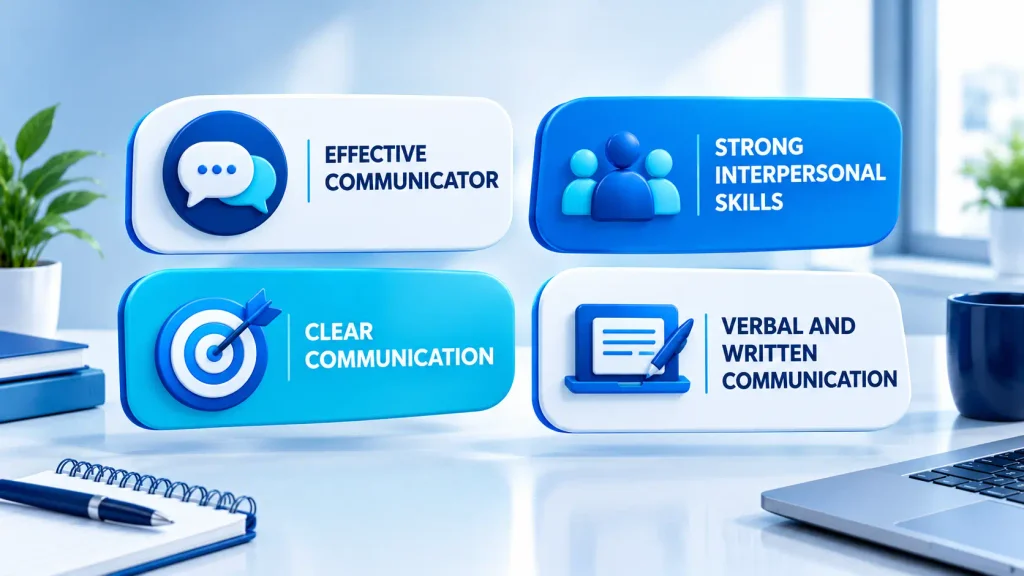
Another way to say great communication skills includes strong communication abilities, excellent interpersonal skills, effective verbal and written communication, and clear communication skills. These alternatives help you describe your ability to share ideas, listen actively, build relationships, and work with others. Choose a phrase that matches your audience, purpose, and level of formality.
Key Takeaways
- Use specific phrases such as “effective communicator” or “strong interpersonal skills” to describe your communication strengths.
- Choose professional wording for resumes, cover letters, and job interviews.
- Highlight skills such as active listening, clear writing, teamwork, and public speaking.
- Support your claims with real examples instead of relying on general statements.
- Match your wording to the situation, audience, and communication task.
Great communication skills help people share ideas, understand others, solve problems, and build strong working relationships. However, repeating the same phrase in a resume, cover letter, email, or interview can make your writing sound generic.
The right alternative can make your abilities clearer and more convincing. Whether you want to describe your professional strengths or recognize someone else’s communication style, these expressions will help you choose more precise language.
What Does “Great Communication Skills” Mean?

“Great communication skills” refers to the ability to express ideas clearly, listen carefully, understand different perspectives, and respond appropriately. These skills can include speaking, writing, active listening, nonverbal communication, and adjusting your message to suit an audience.
People commonly use this phrase in resumes, job descriptions, performance reviews, interviews, and everyday conversations. Because communication covers many different abilities, a more specific expression can help explain exactly what someone does well.
Examples of Great Communication Skills
- Explaining complex information in simple language.
- Writing clear and professional emails.
- Listening carefully before responding.
- Resolving disagreements respectfully.
- Presenting ideas confidently to a group.
Why Specific Wording Matters
A phrase such as “strong written communication skills” tells an employer more than the general statement “great communication skills.” Specific wording also helps readers understand your strengths without guessing what you mean.
Why Use Other Ways to Say “Great Communication Skills”?

Using alternative expressions makes your writing more natural, specific, and professional. It also helps you avoid repeating the same words across different sections of your resume or professional profile.
Consider using alternatives when you want to:
- Avoid repetition: Keep resumes, cover letters, and articles engaging.
- Sound professional: Choose wording that fits workplace expectations.
- Show a specific strength: Highlight writing, speaking, listening, or collaboration.
- Improve credibility: Describe abilities that you can support with examples.
- Match your audience: Use formal language for employers and relaxed language for everyday conversations.
How to Choose the Right Alternative
Start by identifying the communication skill you want to emphasize. Then choose wording that reflects that ability rather than simply replacing one general phrase with another.
A Quick Selection Guide
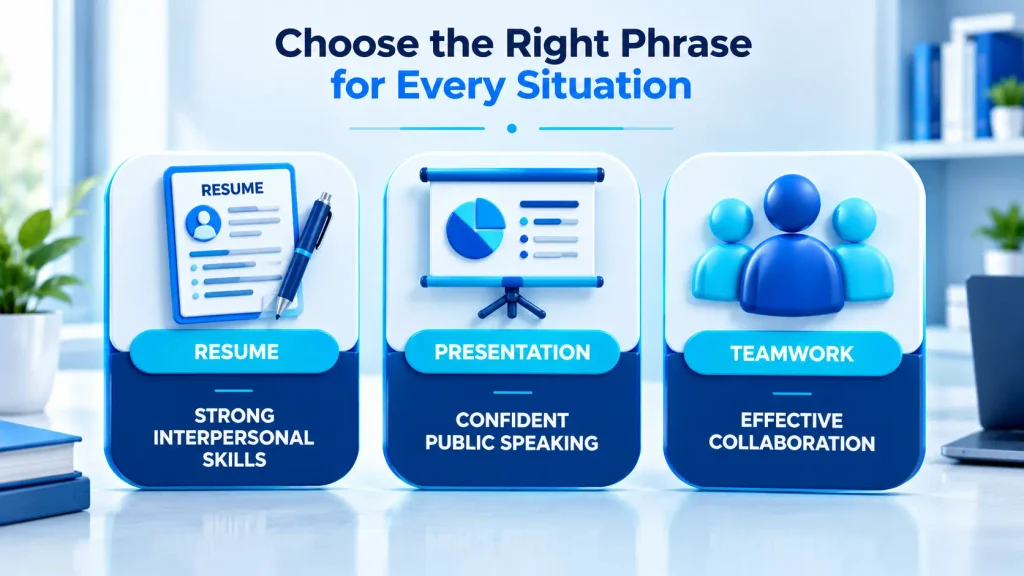
- For resumes: “Strong interpersonal skills” or “Effective communicator.”
- For writing tasks: “Excellent written communication skills.”
- For presentations: “Confident public speaking skills.”
- For teamwork: “Strong collaboration and communication skills.”
- For everyday conversation: “Clear and thoughtful communicator.”
10 Best Other Ways to Say “Great Communication Skills”
1. Strong Communication Abilities
Meaning
“Strong communication abilities” describes a person’s ability to express ideas, exchange information, and understand others effectively. It is a flexible phrase that works when you want to describe communication as a broad professional strength.
Best For
Professional, Formal
Example 1
“My strong communication abilities help me explain project requirements to clients and colleagues.”
Example 2
“The position requires strong communication abilities and a practical approach to problem-solving.”
Quick Tip
Use this phrase in professional profiles when you want to emphasize communication without focusing on only speaking or writing.
2. Excellent Interpersonal Skills
Meaning
“Excellent interpersonal skills” emphasizes how well someone interacts with other people. It can include listening, empathy, relationship-building, cooperation, and respectful communication.
Best For
Professional, Formal, Friendly
Example 1
“Her excellent interpersonal skills help her build trust with customers from different backgrounds.”
Example 2
“The team leader uses excellent interpersonal skills to address concerns and maintain positive working relationships.”
Quick Tip
Choose this expression when your communication strengths involve teamwork, customer service, leadership, or relationship management.
3. Effective Communication Skills
Meaning
“Effective communication skills” focuses on achieving a clear and useful outcome when exchanging information. It suggests that a person can deliver messages, understand responses, and reduce confusion.
Best For
Professional, Formal, Polite
Example 1
“Effective communication skills allow our team to resolve customer issues without unnecessary delays.”
Example 2
“Candidates should demonstrate effective communication skills when explaining technical information to nontechnical audiences.”
Quick Tip
This is a reliable option for job applications because it sounds professional and applies to many industries.
4. Excellent Verbal and Written Communication
Meaning
This phrase specifically highlights the ability to communicate through both speaking and writing. It works well when a role requires conversations, presentations, reports, emails, or written instructions.
Best For
Professional, Formal
Example 1
“The marketing coordinator brings excellent verbal and written communication to every client project.”
Example 2
“This role requires excellent verbal and written communication to keep internal teams informed.”
Quick Tip
Use this phrase when a job description explicitly mentions both verbal and written communication.
5. Clear and Concise Communication
Meaning
“Clear and concise communication” describes the ability to share information in a way that is easy to understand and free from unnecessary detail. It is especially useful when accuracy and efficiency matter.
Best For
Professional, Formal, Polite
Example 1
“His clear and concise communication keeps weekly project meetings focused.”
Example 2
“Please use clear and concise communication when documenting the new procedures.”
Quick Tip
Choose this expression for roles involving technical writing, project coordination, reporting, or explaining complex information.
6. Strong Interpersonal Communication
Meaning
“Strong interpersonal communication” emphasizes the way a person exchanges information and responds to others during interactions. It combines clear expression with listening, awareness, and an understanding of social cues.
Best For
Professional, Formal, Warm
Example 1
“Strong interpersonal communication helps the nurse explain care instructions to patients and families.”
Example 2
“The supervisor relies on strong interpersonal communication to handle sensitive employee concerns.”
Quick Tip
Use this phrase when the ability to communicate respectfully and understand others is central to the role.
7. An Effective Communicator
Meaning
“An effective communicator” describes someone who shares ideas clearly and adjusts their approach to different audiences. It is a natural, direct way to describe a person’s overall communication ability.
Best For
Professional, Friendly, Formal
Example 1
“I’m an effective communicator who can turn complex requirements into practical instructions.”
Example 2
“Although Maya is new to management, she has already proved herself to be an effective communicator.”
Quick Tip
This phrase works especially well in a resume summary, LinkedIn profile, or interview answer when followed by a concrete example.
8. Exceptional Listening and Communication Skills
Meaning
This expression highlights both the ability to communicate ideas and the willingness to understand other people. It signals that communication involves listening carefully, asking useful questions, and responding thoughtfully.
Best For
Professional, Warm, Polite
Example 1
“Exceptional listening and communication skills help our support team understand customer concerns.”
Example 2
“The mentor demonstrates exceptional listening and communication skills when guiding new employees.”
Quick Tip
Choose this wording for counseling, customer support, management, teaching, and other roles that require careful listening.
9. Confident Public Speaking Skills
Meaning
“Confident public speaking skills” refers to the ability to present information comfortably and clearly to an audience. It emphasizes spoken presentations rather than every aspect of communication.
Best For
Professional, Formal, Friendly
Example 1
“Her confident public speaking skills make her a strong candidate to lead client presentations.”
Example 2
“The training program helps participants develop confident public speaking skills through regular practice.”
Quick Tip
Use this phrase when describing presentations, speeches, workshops, training sessions, or speaking at professional events.
10. Strong Collaboration and Communication Skills
Meaning
This phrase combines clear communication with the ability to work productively with other people. It suggests that someone can exchange ideas, coordinate responsibilities, and contribute to shared goals.
Best For
Professional, Formal, Friendly
Example 1
“Strong collaboration and communication skills helped the product team deliver the project on schedule.”
Example 2
“We are looking for a candidate with strong collaboration and communication skills who can work across departments.”
Quick Tip
This expression is useful for team-based positions, project management, cross-functional work, and leadership roles.
Comparison Table
Use this table to find the most suitable alternative for your situation.
| Alternative | Best Used In | Tone |
|---|---|---|
| Strong communication abilities | Professional profiles | Professional |
| Excellent interpersonal skills | Teamwork and customer service | Professional |
| Effective communication skills | Resumes and job descriptions | Formal |
| Excellent verbal and written communication | Applications and job requirements | Formal |
| Clear and concise communication | Reports and technical tasks | Direct |
| Strong interpersonal communication | Leadership and sensitive conversations | Professional |
| An effective communicator | Interviews and personal profiles | Confident |
| Exceptional listening and communication skills | Support and mentoring | Warm |
| Confident public speaking skills | Presentations and training | Confident |
| Strong collaboration and communication skills | Team-based roles | Professional |
Common Mistakes When Describing Communication Skills

Choosing the right phrase is only part of effective writing. Avoid these common mistakes to make your message more credible and appropriate.
1. Using Casual Phrases in Professional Documents
Expressions such as “I’m great at talking to people” may sound natural in conversation but can seem informal in a resume. Use “strong interpersonal skills” or “effective communicator” for a more professional tone.
2. Choosing Overly Formal Language
Unnecessarily complicated wording can make simple ideas harder to understand. Instead of using an elaborate phrase to describe your abilities, choose direct language that readers can understand quickly.
3. Repeating the Same Phrase
Using “great communication skills” several times can make your writing feel repetitive. Vary your wording based on the skill you want to highlight, but avoid adding alternatives just for variety.
4. Making Unsupported Claims
Calling yourself an exceptional communicator does not show an employer how you perform. Strengthen your statement with evidence, such as leading client meetings, preparing clear reports, or resolving customer concerns.
5. Ignoring the Context
Public speaking, written communication, and active listening are different skills. Choose a phrase that matches the actual task instead of using one general expression for every situation.
Frequently Asked Questions
1. What is a professional way to say “great communication skills”?
“Effective communication skills,” “strong interpersonal skills,” and “an effective communicator” are professional alternatives. The best choice depends on the context. For example, use “clear and concise communication” for reporting tasks and “strong interpersonal skills” when discussing teamwork or relationship-building.
2. How do you describe good communication skills on a resume?
Use a phrase that matches the job requirements, such as “excellent verbal and written communication” or “strong collaboration and communication skills.” Whenever possible, include evidence of your abilities. For example, describe how you explained complex information, improved team coordination, or handled client questions.
3. What is another word for a good communicator?
“Effective communicator” is one of the most natural professional alternatives. Depending on the situation, you can also use “articulate,” “persuasive,” “approachable,” or “thoughtful listener.” Each term describes a different strength, so select one that accurately reflects the person’s communication style.
4. How can I say I have excellent communication skills in an interview?
Explain your strength and support it with a real example. You might say, “I communicate clearly with both technical and nontechnical teams, which helps us agree on priorities.” A specific example of how you handled a conversation or solved a misunderstanding makes your answer more convincing.
5. What are some synonyms for strong communication skills?
Useful alternatives include “effective communication abilities,” “excellent interpersonal skills,” “clear communication,” “verbal and written communication proficiency,” and “active listening skills.” These expressions are related but not identical. Choose the one that best describes your actual strength and the needs of your audience.
6. Is “excellent interpersonal skills” the same as “great communication skills”?
Not exactly. Communication skills include speaking, writing, listening, and sharing information, while interpersonal skills focus more on interacting with other people. The two areas overlap, but interpersonal skills also involve empathy, cooperation, and relationship-building.
7. How do I describe communication skills without sounding boastful?
Use factual language and support it with examples. Instead of saying, “I am an outstanding communicator,” explain that you regularly present project updates, write clear instructions, or help colleagues resolve misunderstandings. Evidence-based statements sound more credible than broad claims.
8. What communication skills do employers value most?
Employers often value clear speaking and writing, active listening, teamwork, adaptability, and the ability to explain information accurately. The priorities vary by role. A customer service position may require empathy and listening, while a management role may place greater emphasis on feedback, presentations, and conflict resolution.
For related wording choices, see How to Say “Heads Up” Professionally in an Email, Another Way to Say Hope All Is Well and Another Way to Say Hope Everything Is Okay.
Conclusion
Finding another way to say great communication skills helps you describe your strengths more clearly and avoid generic wording. The best expression depends on what you want to communicate, who will read your message, and where you plan to use it.
For resumes and cover letters, consider “effective communication skills,” “excellent verbal and written communication,” or “strong interpersonal skills.” If you want to emphasize presentations, “confident public speaking skills” is more precise. For team-based roles, “strong collaboration and communication skills” highlights your ability to work toward shared goals.
Rather than simply claiming that you communicate well, show how you listen, explain ideas, solve problems, and help others understand important information. Choosing the right words to describe your communication skills can make your resume and professional profile more effective.

The FrontiersPost editorial team writes and reviews every guide to word and phrase alternatives, with clear meanings, tone notes and example sentences for everyday, academic and professional English.