

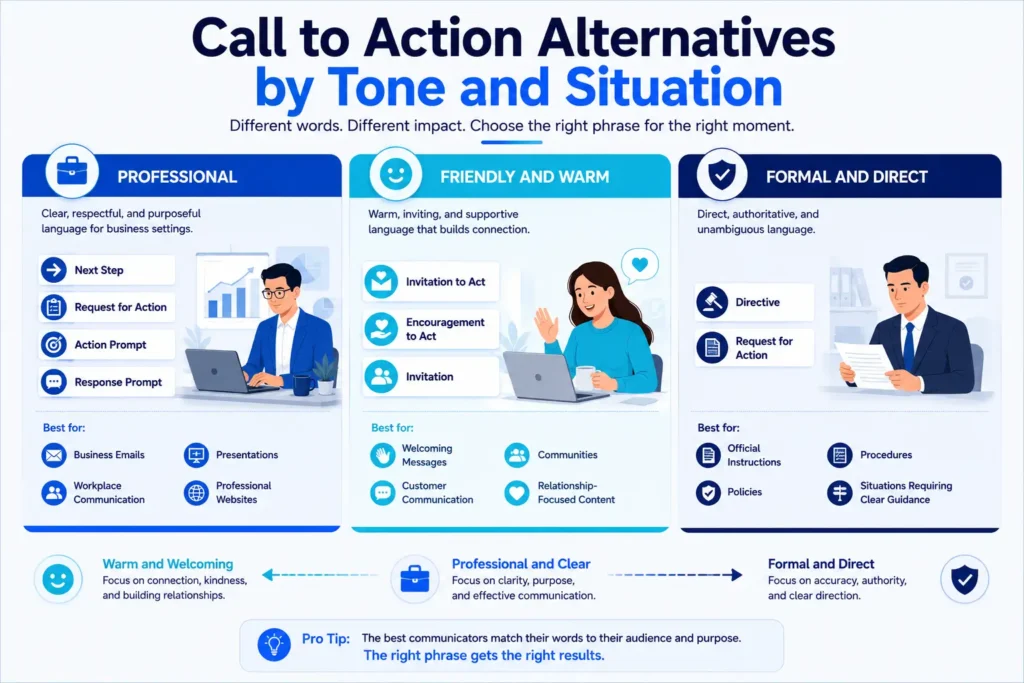
Another way to say call to action includes phrases such as next step, invitation to act, prompt, directive, request for action, or response prompt. The best alternative depends on whether you are writing marketing copy, a professional document, a presentation, or everyday communication.
Key Takeaways
- “Call to action” can be replaced with several phrases depending on the context.
- “Next step” works well in professional and customer-focused communication.
- “Invitation to act” has a friendly, less forceful tone.
- Marketing language often benefits from specific terms such as “response prompt” or “conversion prompt.”
- The best alternative should match your audience and the action you want them to take.
A call to action is a phrase, statement, or instruction that encourages someone to do something. You often see calls to action in advertisements, websites, emails, presentations, and social media posts.
However, repeating “call to action” can make your writing sound predictable. Depending on the situation, you may want a more professional, friendly, formal, or specific alternative.
This guide explains what the phrase means and gives you 10 useful alternatives you can use with confidence.
What Does “Call to Action” Mean?
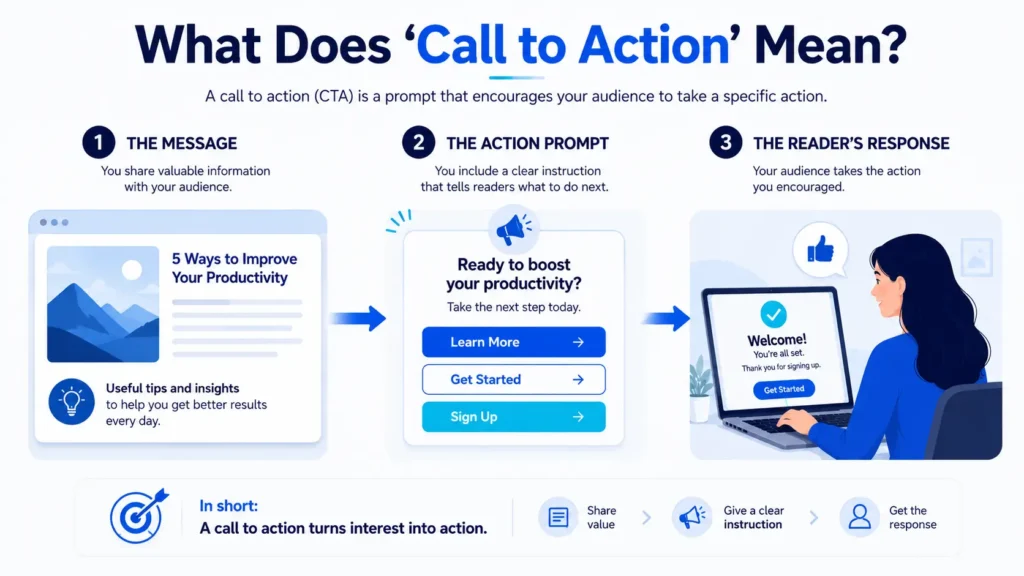
A call to action, often shortened to CTA, is wording designed to encourage a person to take a specific step. That action might be buying a product, signing up for a newsletter, downloading a file, or contacting a business.
For example, “Shop now,” “Learn more,” and “Get started” are all common calls to action.
People use calls to action because they give readers a clear direction. Instead of leaving someone wondering what to do next, a CTA tells them the next step.
You will commonly find them in:
- Marketing campaigns
- Business websites
- Email newsletters
- Social media posts
- Sales presentations
- Landing pages
- Professional communications
Why Use Other Ways to Say “Call to Action”?

Using another phrase can help your writing fit the situation more naturally. In some settings, “call to action” sounds too technical or too closely connected to marketing.
Alternative wording can help you:
- Avoid repeating the same phrase
- Sound more natural and specific
- Match a professional or formal setting
- Use language your audience understands
- Describe the purpose more clearly
The right choice depends on what you are writing and who will read it.
10 Best Other Ways to Say “Call to Action”

1. Next Step
Meaning
“Next step” refers to the action someone should take after receiving information. It is clear, simple, and useful in both business and customer communication.
This phrase focuses on what happens next rather than using marketing terminology.
Best For
Professional, Friendly, Polite
Example 1
The next step is to complete the registration form before Friday.
Example 2
After reviewing the proposal, please let us know your preferred next step.
Quick Tip
Use “next step” when you want to guide someone without sounding overly promotional.
2. Invitation to Act
Meaning
An “invitation to act” encourages someone to take action in a friendly and welcoming way. It feels less demanding than a traditional call to action.
This option works especially well when participation is optional.
Best For
Friendly, Warm, Professional
Example 1
The final section of the email includes an invitation to act by scheduling a free consultation.
Example 2
Our website should end with a clear invitation to act for interested visitors.
Quick Tip
Choose this phrase when you want your message to feel encouraging rather than forceful.
3. Prompt
Meaning
A “prompt” is a message or signal that encourages a response or action. It is short and flexible, making it useful in digital content and user experiences.
The term can describe a button, question, message, or instruction.
Best For
Professional, Casual
Example 1
The survey ends with a prompt asking customers to share their feedback.
Example 2
Add a simple prompt that encourages visitors to request more information.
Quick Tip
Use “prompt” when the wording encourages an immediate response.
4. Request for Action
Meaning
“Request for action” clearly describes a message asking someone to do something. It is more direct and formal than “invitation to act.”
This phrase works well when a specific response is needed.
Best For
Professional, Formal, Polite
Example 1
The manager included a clear request for action in the final paragraph.
Example 2
Please review the request for action and respond by the deadline.
Quick Tip
Use this phrase in workplace communication when you need a clear response.
5. Action Prompt
Meaning
An “action prompt” is wording that encourages a person to complete a specific task. It is similar to a call to action but sounds more concise and modern.
It works particularly well when discussing website design or digital content.
Best For
Professional, Casual
Example 1
The landing page needs a stronger action prompt near the sign-up form.
Example 2
A clear action prompt can help users understand what to do after reading the article.
Quick Tip
Use this alternative when discussing user experience or online content.
6. Directive
Meaning
A “directive” is an instruction that tells someone what they should do. It has a stronger and more authoritative tone than most other alternatives.
Because of its direct nature, it works best when clear guidance is necessary.
Best For
Professional, Formal
Example 1
The safety notice ends with a directive to wear protective equipment.
Example 2
Each section includes a directive explaining the required procedure.
Quick Tip
Avoid “directive” when you want a warm or conversational tone.
7. Response Prompt
Meaning
A “response prompt” specifically encourages someone to reply or react. It is useful when the desired action involves feedback, communication, or engagement.
This phrase makes the intended response clear.
Best For
Professional, Friendly
Example 1
The email includes a response prompt asking clients to confirm their attendance.
Example 2
Use a response prompt at the end of the post to encourage comments.
Quick Tip
Choose this term when your main goal is to get a reply or reaction.
8. Encouragement to Act
Meaning
“Encouragement to act” describes language that motivates someone to take a step without sounding demanding. It has a supportive and positive tone.
This alternative can work well in educational, nonprofit, and customer-focused content.
Best For
Friendly, Warm, Polite
Example 1
The article closes with encouragement to act on the information provided.
Example 2
The campaign uses positive language as encouragement to act.
Quick Tip
Use this phrase when motivation is more important than urgency.
9. Invitation
Meaning
An “invitation” asks someone to participate, respond, or take part. It feels open and welcoming, especially when the audience has a choice.
The phrase can be more natural than “call to action” in community or relationship-focused communication.
Best For
Friendly, Warm, Polite
Example 1
The newsletter ends with an invitation to join the upcoming webinar.
Example 2
We included an invitation for readers to share their experiences.
Quick Tip
Use “invitation” when the action should feel voluntary and welcoming.
10. Conversion Prompt
Meaning
A “conversion prompt” is a marketing-focused term for wording designed to move a visitor toward a desired outcome. That outcome might be a purchase, sign-up, download, or inquiry.
It is more technical than “call to action” and works best when discussing marketing performance.
Best For
Professional, Formal
Example 1
The marketing team tested several conversion prompts on the product page.
Example 2
A stronger conversion prompt may increase newsletter sign-ups.
Quick Tip
Use this phrase mainly in marketing discussions where conversions are the primary goal.
Comparison Table
| Alternative | Best Used In | Tone |
| Next Step | Emails, business communication | Professional, friendly |
| Invitation to Act | Customer and community communication | Warm, encouraging |
| Prompt | Digital content and user experience | Neutral, modern |
| Request for Action | Workplace and formal communication | Direct, professional |
| Action Prompt | Websites and digital marketing | Clear, modern |
| Directive | Instructions and official guidance | Formal, authoritative |
| Response Prompt | Emails, surveys, and social posts | Professional, engaging |
| Encouragement to Act | Educational and supportive content | Positive, warm |
| Invitation | Events and community communication | Friendly, welcoming |
| Conversion Prompt | Marketing and sales | Technical, professional |
Common Mistakes When Choosing an Alternative
1. Using a Marketing Term in Every Situation
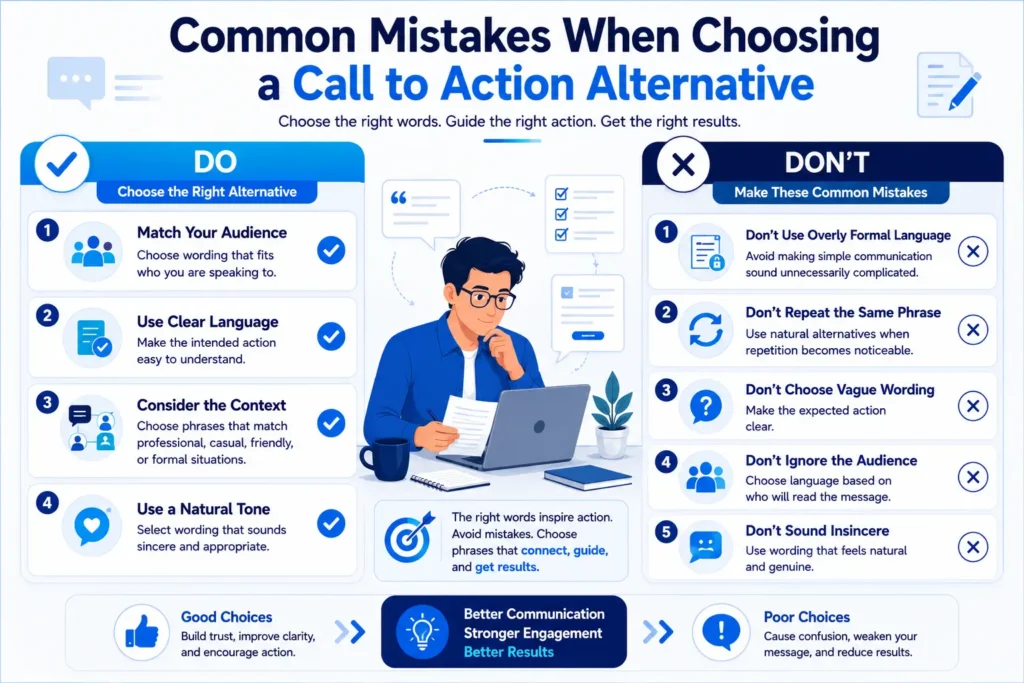
Words such as “conversion prompt” may sound too technical in a friendly email or personal message. Choose language that matches the audience.
2. Choosing a Phrase That Sounds Too Formal
A word like “directive” can feel cold when you are inviting customers or community members to participate.
3. Being Too Vague
An alternative should still explain what you mean. “Next step” works best when the next action is clearly stated.
4. Forgetting the Desired Action
The wording should match the goal. If you want a reply, “response prompt” may work better than a general “invitation.”
5. Sounding Too Forceful
Not every message needs a strong command. Friendly audiences may respond better to an invitation or encouragement.
Frequently Asked Questions
What is another word for call to action?
Another word for “call to action” can be prompt, request for action, directive, invitation, or next step. The best choice depends on the context. Marketing discussions may use “conversion prompt,” while professional emails often sound more natural with “next step” or “request for action.”
What can I say instead of call to action in marketing?
In marketing, you can say action prompt, conversion prompt, response prompt, or invitation to act. “Conversion prompt” is especially useful when discussing content designed to encourage sales, registrations, or other measurable customer actions.
Is “next step” the same as a call to action?
Not exactly, but the phrases are closely related. A call to action tells someone what to do, while a “next step” identifies what should happen after the current stage. In many professional situations, “next step” is a more natural alternative.
What is a professional alternative to call to action?
A professional alternative includes request for action, next step, action prompt, or response prompt. These phrases are useful in reports, presentations, emails, and business discussions because they clearly describe the purpose without relying on marketing jargon.
What is a softer way to say call to action?
A softer alternative is invitation, invitation to act, or encouragement to act. These phrases feel welcoming and less demanding. They work well when you want to encourage participation without putting pressure on the reader.
Can I use “directive” instead of “call to action”?
Yes, but only in the right context. A directive is usually stronger and more authoritative than a call to action. It works well for instructions, policies, and official guidance but may sound too forceful in friendly marketing or customer communication.
What is a call to action in an email?
In an email, a call to action is the part that tells the reader what to do next. It might ask them to reply, schedule a meeting, download a document, or make a decision. “Next step” or “request for action” can describe this purpose professionally.
Why should I use different terms for call to action?
Using different terms helps you match your language to the audience and situation. It also prevents repetition and can make your writing clearer. A friendly invitation, a professional request, and a formal directive all encourage action, but they create different impressions.
Conclusion
Finding another way to say call to action can make your writing more natural and better suited to the situation. The best alternative depends on your audience, purpose, and tone.
Use next step for clear professional communication, invitation to act for a warmer approach, and request for action when you need a direct response. In marketing, terms such as action prompt and conversion prompt may provide more specific meaning.
Avoid choosing an alternative simply because it sounds more impressive. When looking for another way to say “call to action,” clear and effective language usually works best. Think about what you want your reader to do, then choose a phrase that explains that purpose naturally and respectfully.

Melody Schaefer is the Founder and Editor-in-Chief of FrontiersPost, where she oversees the publication of clear, useful, and thoughtfully researched content for modern readers. Her editorial focus includes language, communication, vocabulary, writing, and practical topics that help readers understand information with greater clarity and confidence.
At FrontiersPost, Melody works with writers and editors to maintain consistent editorial standards, improve content quality, and ensure that published articles are useful, accessible, and easy to understand. She is particularly interested in clear communication and presenting complex or easily confused topics in a straightforward way.
As Editor-in-Chief, she is also responsible for guiding the site’s editorial direction, reviewing content standards, and helping ensure that articles are regularly maintained and improved as information evolves.