

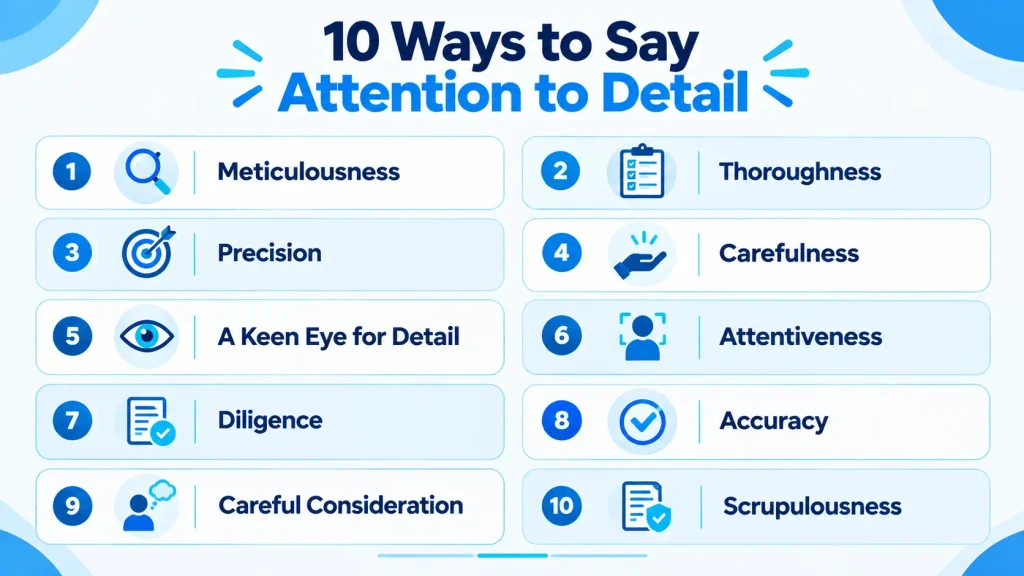
Another way to say attention to detail includes meticulousness, thoroughness, precision, carefulness, and a keen eye for detail. The best choice depends on context. For resumes and professional writing, “meticulousness” or “strong eye for detail” sounds natural, while “thoroughness” works well in formal and workplace settings.
Key Takeaways
- Meticulousness is a strong choice for professional and formal contexts.
- Thoroughness emphasizes careful and complete work.
- Precision highlights accuracy and exactness.
- A keen eye for detail sounds natural and conversational.
- Choose an alternative based on the tone, audience, and situation.
What Does “Another Way to Say Attention to Detail” Mean?
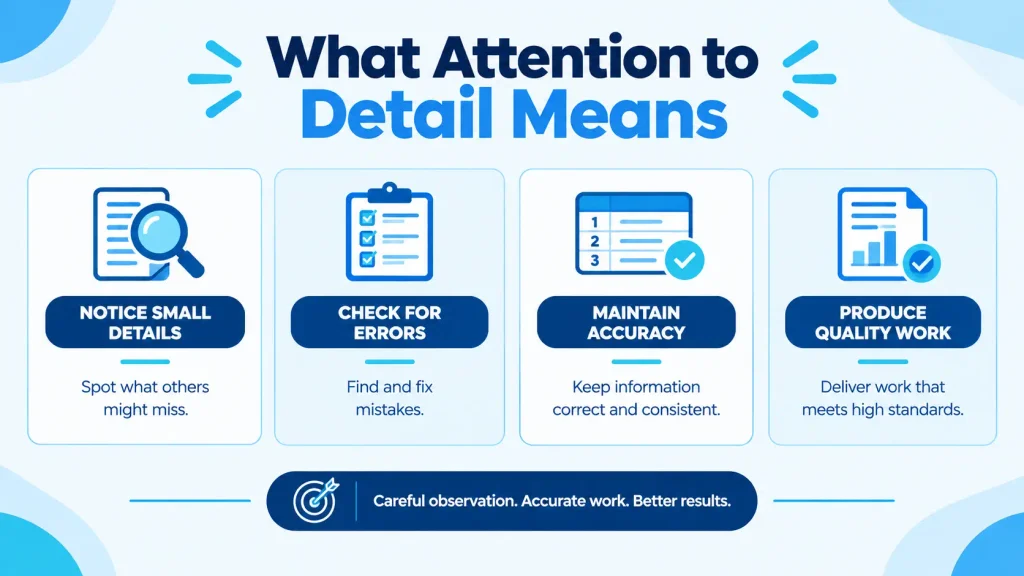
“Another way to say attention to detail” refers to alternative words or phrases that describe someone’s ability to notice small details, maintain accuracy, and complete work carefully. The phrase often describes a valuable personal or professional skill.
People commonly use alternatives to attention to detail in resumes, cover letters, performance reviews, job interviews, workplace communication, academic writing, and professional profiles.
Finding the right alternative can make your writing more specific. For example, “precision” focuses on accuracy, while “thoroughness” suggests that someone carefully examines every part of a task.
Why Use Other Ways to Say “Attention to Detail”?
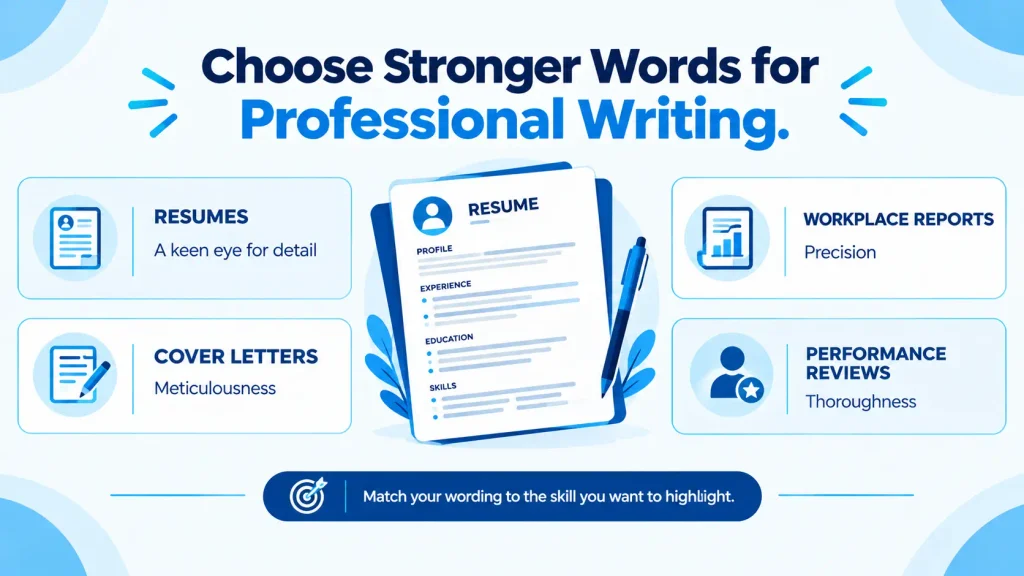
Using different expressions can make your writing more natural and precise. Instead of repeating the same phrase, you can choose wording that highlights the exact quality you want to describe.
Other benefits include:
- Avoiding repetitive language
- Making professional writing more engaging
- Describing specific strengths more accurately
- Matching formal, professional, or friendly situations
- Making resumes and cover letters more persuasive
- Showing whether you mean accuracy, care, or thoroughness
10 Best Other Ways to Say “Attention to Detail”
1. Meticulousness
Meaning
Meticulousness describes extreme care and attention when completing a task. It suggests that someone checks small details carefully and aims to avoid errors.
Best For
- Professional
- Formal
Example 1
Her meticulousness helped the team identify several errors before the report was submitted.
Example 2
The position requires a high level of meticulousness when reviewing financial records.
Quick Tip
Use “meticulousness” when you want to emphasize exceptionally careful work, especially in professional or formal writing.
2. Thoroughness
Meaning
Thoroughness means completing something carefully and completely rather than rushing through it. It emphasizes making sure that important details, steps, or requirements are not overlooked.
Best For
- Professional
- Formal
- Polite
Example 1
His thoroughness made him an excellent choice for reviewing the project proposal.
Example 2
We appreciate the thoroughness you brought to the research process.
Quick Tip
Choose “thoroughness” when the main idea is completeness rather than extreme precision.
3. Precision
Meaning
Precision focuses on accuracy, exactness, and careful execution. It works particularly well when small differences or errors can significantly affect the final result.
Best For
- Professional
- Formal
Example 1
The role demands precision when entering and analyzing customer data.
Example 2
Her precision in preparing the measurements contributed to the project’s success.
Quick Tip
Use “precision” when accuracy is more important than simply being careful.
4. Carefulness
Meaning
Carefulness describes the habit of acting cautiously and thoughtfully to prevent mistakes. It is straightforward and easy to understand, although it can sound less polished than some alternatives in formal writing.
Best For
- Casual
- Friendly
- Professional
Example 1
His carefulness with confidential documents earned the trust of his coworkers.
Example 2
The carefulness she showed during the installation prevented unnecessary problems.
Quick Tip
“Carefulness” is useful in everyday language, but consider “thoroughness” or “meticulousness” for a polished resume.
5. A Keen Eye for Detail
Meaning
A keen eye for detail describes someone who notices small or easily overlooked details. It sounds natural and positive, making it especially useful when describing a person’s ability rather than an abstract quality.
Best For
- Professional
- Friendly
- Warm
Example 1
Her keen eye for detail helps ensure that every client presentation looks polished.
Example 2
A keen eye for detail is one of his strongest qualities as a designer.
Quick Tip
This phrase is especially effective in resumes, interviews, recommendations, and performance reviews.
6. Attentiveness
Meaning
Attentiveness refers to being alert, focused, and aware of what is happening. It can describe careful work as well as the ability to listen closely and notice important information.
Best For
- Professional
- Polite
- Formal
Example 1
Her attentiveness during client meetings helps her understand concerns that others may miss.
Example 2
The manager praised his attentiveness when handling customer requests.
Quick Tip
Use “attentiveness” when attention involves both observing details and actively listening.
7. Diligence
Meaning
Diligence describes consistent, careful, and responsible effort. It suggests that someone takes a task seriously and works steadily to achieve accurate and reliable results.
Best For
- Professional
- Formal
Example 1
Her diligence in checking each application helped reduce processing errors.
Example 2
The project was completed successfully through the team’s diligence and careful planning.
Quick Tip
“Diligence” is a strong choice for formal writing when you want to emphasize sustained effort as well as carefulness.
8. Accuracy
Meaning
Accuracy focuses on being correct and free from mistakes. It is a practical alternative when the specific meaning of attention to detail relates directly to producing reliable information or results.
Best For
- Professional
- Formal
Example 1
Accuracy is essential when preparing monthly financial statements.
Example 2
Her accuracy when reviewing technical specifications has consistently impressed the engineering team.
Quick Tip
Use “accuracy” when you want to emphasize the quality of the final result rather than the process of checking details.
9. Careful Consideration
Meaning
Careful consideration suggests that someone examines information, choices, or consequences before making a decision. It works well when attention to detail involves thoughtful judgment rather than simple proofreading.
Best For
- Formal
- Professional
- Polite
Example 1
The committee reached its decision after careful consideration of each proposal.
Example 2
Thank you for giving the request such careful consideration.
Quick Tip
Use this phrase when describing thoughtful decision-making, especially in formal correspondence.
10. Scrupulousness
Meaning
Scrupulousness describes extremely careful attention to accuracy, standards, or ethical requirements. It is more formal than most alternatives and can suggest a strong commitment to doing things correctly.
Best For
- Formal
- Professional
Example 1
Her scrupulousness in maintaining research records strengthened the credibility of the study.
Example 2
The auditor was known for his scrupulousness when examining company records.
Quick Tip
Use “scrupulousness” sparingly because it is formal and less common in everyday American English.
Comparison Table
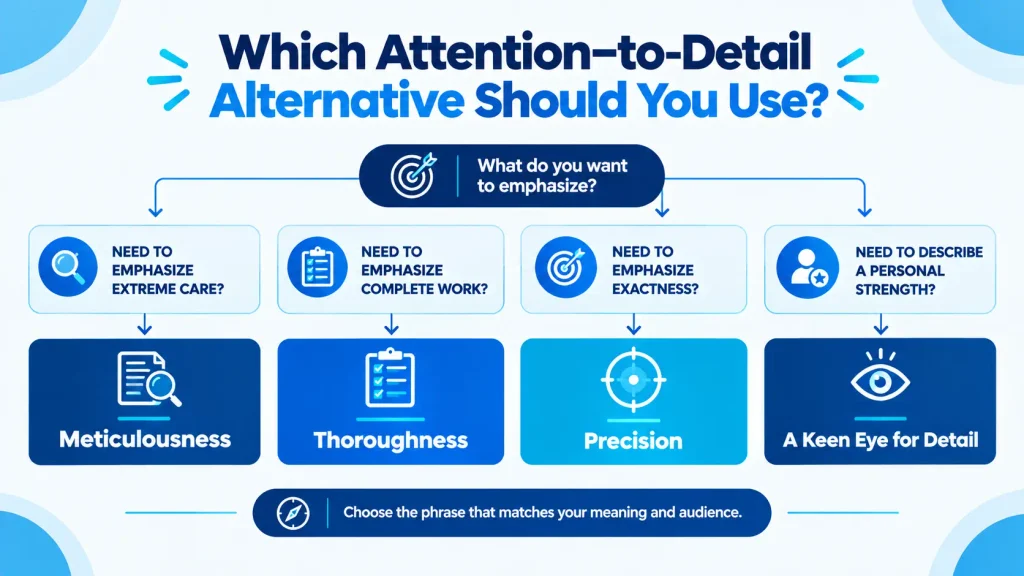
| Alternative | Best Used In | Tone |
|---|---|---|
| Meticulousness | Resumes, professional writing | Formal, professional |
| Thoroughness | Workplace, academic writing | Professional, formal |
| Precision | Technical and professional contexts | Formal, professional |
| Carefulness | Everyday and workplace contexts | Friendly, neutral |
| A keen eye for detail | Resumes, interviews, recommendations | Professional, warm |
| Attentiveness | Customer service, workplace communication | Polite, professional |
| Diligence | Performance reviews, formal writing | Formal, professional |
| Accuracy | Technical, financial, academic contexts | Professional, formal |
| Careful consideration | Decisions, emails, formal correspondence | Polite, formal |
| Scrupulousness | Highly formal or specialized writing | Formal, professional |
Common Mistakes
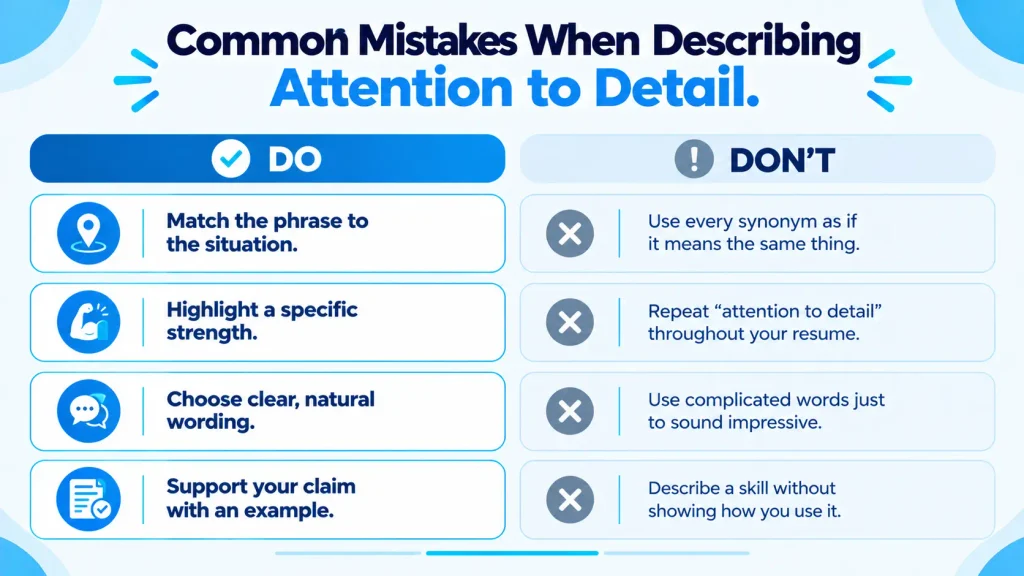
1. Using Casual Phrases in Professional Writing
Not every alternative works equally well in a formal resume or business document. A phrase such as “a keen eye for detail” is professional, but overly casual wording may weaken the overall impression.
2. Choosing an Overly Formal Word
Words such as “scrupulousness” can sound impressive but may feel unnecessarily complicated. Choose simpler language when “thoroughness” or “precision” communicates the idea clearly.
3. Treating All Alternatives as Exact Synonyms
These expressions have slightly different meanings. “Accuracy” focuses on correctness, while “diligence” emphasizes careful and consistent effort.
4. Ignoring the Context
The best phrase depends on what you are describing. Use “precision” for exact work, “attentiveness” for focused listening or observation, and “thoroughness” for complete work.
5. Repeating the Same Expression
Using “attention to detail” several times in a resume, cover letter, or recommendation can make the writing feel repetitive. Replace repeated uses with contextually appropriate alternatives.
Frequently Asked Questions
What is a professional way to say “attention to detail”?
Meticulousness, thoroughness, precision, and a keen eye for detail are strong professional alternatives. The best choice depends on what you want to emphasize. “Meticulousness” highlights exceptional care, “precision” emphasizes accuracy, and “thoroughness” focuses on completeness. For resumes, “a keen eye for detail” is also natural and widely understandable.
What is another way to say “attention to detail” on a resume?
On a resume, consider phrases such as “a keen eye for detail,” “meticulousness,” “precision,” or “strong attention to accuracy.” Whenever possible, connect the phrase to an achievement. For example, describing how careful review reduced errors is more persuasive than simply listing attention to detail as a skill.
What is a better word for attention to detail?
There is no single replacement that works in every situation. Meticulousness is a strong choice when you mean exceptional care, while precision works better when accuracy matters most. Thoroughness is ideal when you want to emphasize complete and careful work.
How do you describe someone with great attention to detail?
You can describe the person as meticulous, thorough, precise, attentive, diligent, or someone who has a keen eye for detail. The adjective should match the situation. For example, “She is meticulous when reviewing contracts” emphasizes careful checking, while “He is attentive during client meetings” focuses more on awareness.
Is “meticulousness” a good synonym for attention to detail?
Yes. “Meticulousness” is one of the strongest alternatives when you want to describe exceptionally careful work. However, it can imply a very high level of precision and care. If you simply mean that someone completes work carefully and completely, “thoroughness” may sound more natural.
Is “thoroughness” the same as attention to detail?
The two ideas overlap, but they are not identical. Thoroughness means examining or completing something fully, while attention to detail focuses more specifically on noticing and handling small details. Someone can be thorough by covering every part of a task and attentive to detail by catching tiny errors.
What is a simple way to say “attention to detail”?
Simple alternatives include carefulness, accuracy, precision, and thoroughness. For everyday communication, “careful with details” can also work naturally. The simplest choice depends on your intended meaning. If you are talking about avoiding mistakes, “accuracy” may be clearer than a more abstract synonym.
What is a formal way to say “attention to detail”?
For formal writing, meticulousness, precision, diligence, thoroughness, and scrupulousness are useful choices. “Scrupulousness” is particularly formal and should be used when the context supports it. In most professional situations, “meticulousness” or “thoroughness” will sound polished without making the writing unnecessarily complicated.
For related wording choices, see Another Way to Say “Best Regards”, Another Way to Say Call to Action and Another Way to Say Check Out Our Website.
Conclusion
There are many effective ways to say attention to detail, but the best alternative depends on what you want to emphasize. Use meticulousness for exceptionally careful work, thoroughness for complete work, and precision when accuracy is the main concern. For resumes and professional profiles, a keen eye for detail is a natural and engaging option.
Other choices, such as diligence, attentiveness, accuracy, and careful consideration, work better in specific situations. If you want to explore more related expressions, see these attention to detail synonyms. Rather than replacing the phrase automatically, consider your audience, tone, and intended meaning first.

The FrontiersPost editorial team writes and reviews every guide to word and phrase alternatives, with clear meanings, tone notes and example sentences for everyday, academic and professional English.