

If you want another way to say “best regards,” you can choose an email closing that better matches your relationship and the tone of your message. Common alternatives include “kind regards,” “warm regards,” “sincerely,” “all the best,” and “best wishes.” The right choice depends on how formal, friendly, or personal you want to sound.
Key Takeaways
- “Kind regards” is a polished choice for professional emails.
- “Warm regards” adds a friendly and personal touch.
- “Sincerely” works well for formal business and professional correspondence.
- “All the best” sounds natural and friendly without being too casual.
- Choose your email closing based on the recipient, relationship, and purpose of your message.
What Does “Another Way to Say Best Regards” Mean?
“Best regards” is a polite email and letter closing used to show goodwill toward the recipient. It is common in professional communication because it sounds respectful without being overly formal.
People often use “best regards” when they want to end an email professionally while maintaining a friendly tone. It works well with coworkers, clients, managers, business contacts, and people you do not know personally.
You may look for another way to say “best regards” when you want your message to sound warmer, more formal, more personal, or simply less repetitive.
Why Use Other Ways to Say “Best Regards”?
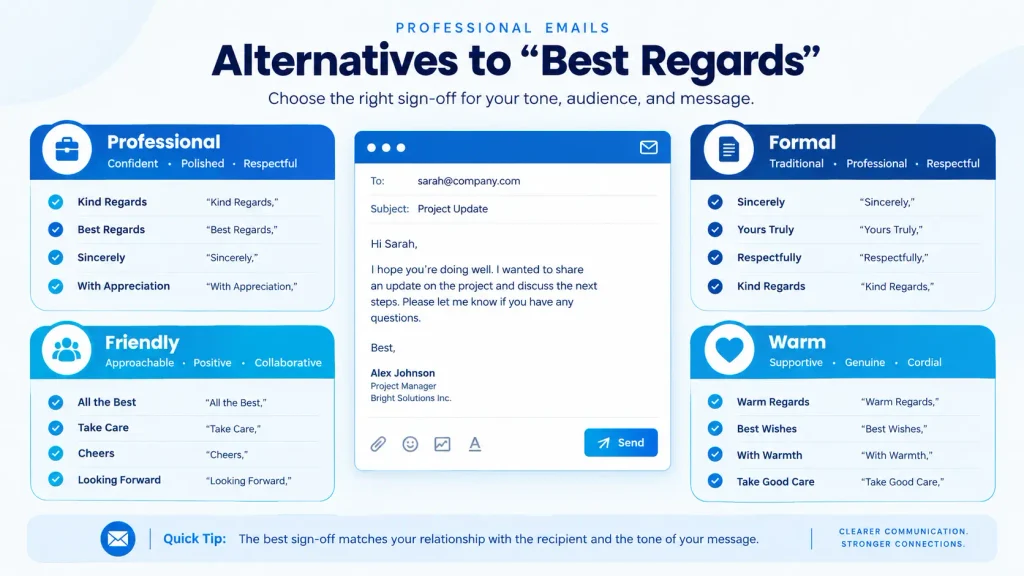
Although “best regards” is versatile, using different closings can make your emails feel more natural and appropriate for the situation.
You might choose an alternative to:
- Match the formality of your message.
- Create a warmer connection with the reader.
- Avoid repeating the same email closing.
- Sound more natural in a familiar relationship.
- Show appreciation or goodwill.
- Make a formal letter feel more polished.
The best closing is usually the one that fits the relationship and tone of the entire email.
10 Best Other Ways to Say “Best Regards”
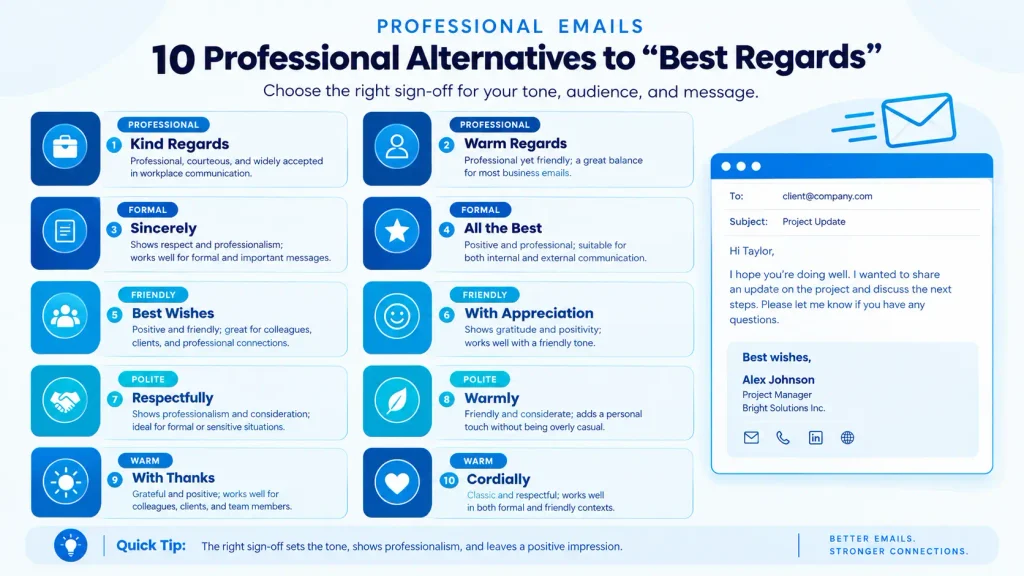
1. Kind Regards
Meaning
“Kind regards” is a polite and professional alternative to “best regards.” It has a slightly warm tone while remaining appropriate for most workplace situations.
Best For
- Professional
- Formal
- Polite
Example 1
Thank you for reviewing the proposal and sharing your feedback.
Kind regards,
Michael
Example 2
I appreciate your help with the scheduling arrangements.
Kind regards,
Rachel
Quick Tip
Use “kind regards” when you want a safe, professional closing that works with both familiar and unfamiliar business contacts.
2. Warm Regards
Meaning
“Warm regards” expresses more warmth and friendliness than “best regards.” It works especially well when you already have a positive relationship with the recipient.
Best For
- Professional
- Friendly
- Warm
Example 1
It was great speaking with you about the project today.
Warm regards,
Daniel
Example 2
Thank you for your continued support throughout the process.
Warm regards,
Emily
Quick Tip
Choose “warm regards” when you want your email to feel personable without becoming too casual.
3. Sincerely
Meaning
“Sincerely” is a traditional and formal closing used in business letters, applications, and other professional correspondence. It gives your message a polished and respectful tone.
Best For
- Formal
- Professional
- Polite
Example 1
Thank you for considering my application. I look forward to hearing from you.
Sincerely,
James Carter
Example 2
Please contact me if you require any additional information.
Sincerely,
Laura Bennett
Quick Tip
Use “sincerely” when writing a formal letter, application, or message where a more traditional tone is appropriate.
4. All the Best
Meaning
“All the best” is a friendly and natural way to close an email. It communicates goodwill while sounding less formal than traditional business closings.
Best For
- Casual
- Friendly
- Warm
Example 1
I hope everything goes smoothly with your presentation tomorrow.
All the best,
Chris
Example 2
Thanks again for your help with the event.
All the best,
Megan
Quick Tip
Use this closing with coworkers, classmates, friends, and professional contacts with whom you have an established relationship.
5. Best Wishes
Meaning
“Best wishes” expresses positive feelings toward the recipient and can work in both professional and personal communication. It often feels slightly warmer than “best regards.”
Best For
- Friendly
- Warm
- Polite
Example 1
Congratulations on your new position. I hope you enjoy the opportunity.
Best wishes,
Andrew
Example 2
I hope your upcoming move goes smoothly.
Best wishes,
Sophie
Quick Tip
“Best wishes” is especially useful when your message involves congratulations, a transition, or another positive personal event.
6. With Appreciation
Meaning
“With appreciation” directly communicates gratitude. It is useful when you want your closing to emphasize that you value the recipient’s assistance, time, or support.
Best For
- Professional
- Formal
- Warm
Example 1
Thank you for taking the time to review my request.
With appreciation,
Nicole
Example 2
Your guidance has been extremely helpful during this project.
With appreciation,
Robert
Quick Tip
Use this closing when appreciation is one of the main purposes of your email.
7. Respectfully
Meaning
“Respectfully” creates a highly courteous and formal tone. It is more serious than “best regards” and should be reserved for situations where a strong sense of respect is appropriate.
Best For
- Formal
- Professional
- Polite
Example 1
Thank you for taking the time to consider my request.
Respectfully,
Thomas Williams
Example 2
I appreciate your attention to this matter and look forward to your response.
Respectfully,
Jennifer Lee
Quick Tip
Use “respectfully” sparingly because it can sound overly formal in ordinary workplace emails.
8. Warmly
Meaning
“Warmly” is a concise closing that creates a personal and friendly impression. It is generally better suited to people you know rather than a first-time business contact.
Best For
- Casual
- Friendly
- Warm
Example 1
Thank you for all your encouragement during the project.
Warmly,
Olivia
Example 2
I enjoyed catching up with you and hearing about your new plans.
Warmly,
Ethan
Quick Tip
Use “warmly” when your relationship is already comfortable and the message has a personal tone.
9. With Thanks
Meaning
“With thanks” is a concise way to show gratitude at the end of a professional message. It sounds polite without being as formal as “sincerely.”
Best For
- Professional
- Friendly
- Polite
Example 1
Thank you for sending the updated documents so quickly.
With thanks,
Amanda
Example 2
I appreciate your assistance with this request.
With thanks,
Brian
Quick Tip
This closing works particularly well when your email focuses on receiving help, information, or a favor.
10. Cordially
Meaning
“Cordially” is a formal and courteous email or letter closing. It communicates respect and professionalism, although it may sound more traditional than everyday workplace language.
Best For
- Formal
- Professional
- Polite
Example 1
Thank you for your consideration. I look forward to discussing this opportunity further.
Cordially,
Steven
Example 2
Please let me know if you have any questions about the information provided.
Cordially,
Maria
Quick Tip
Use “cordially” for formal correspondence when you want a traditional, respectful closing.
Comparison Table
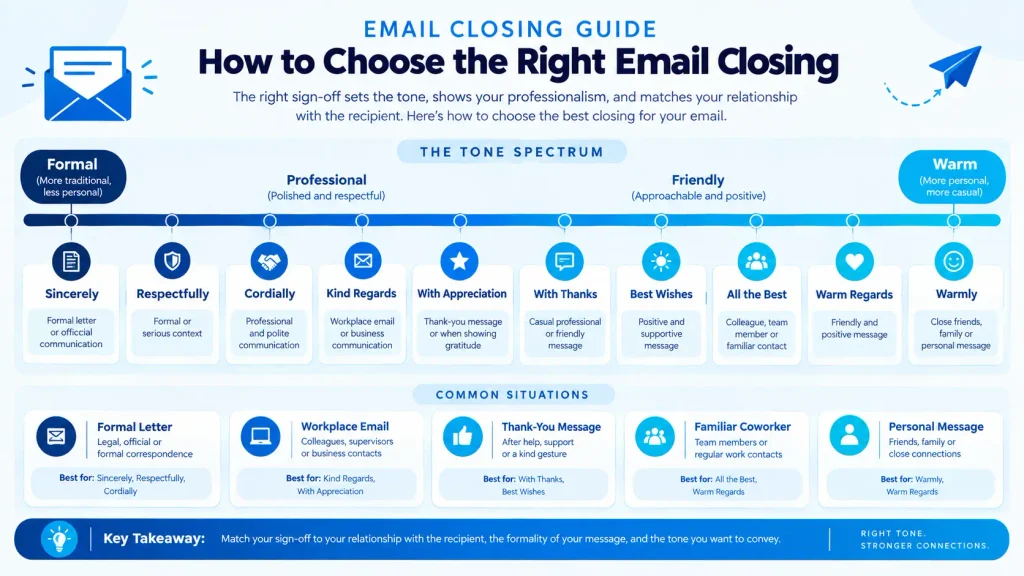
| Alternative | Best Used In | Tone |
| Kind regards | Professional emails | Polite, professional |
| Warm regards | Friendly professional emails | Warm, polished |
| Sincerely | Formal letters and applications | Formal, respectful |
| All the best | Familiar professional contacts | Friendly, relaxed |
| Best wishes | Personal or positive messages | Warm, friendly |
| With appreciation | Thank-you messages | Grateful, professional |
| Respectfully | Formal correspondence | Very polite, formal |
| Warmly | Personal messages | Warm, friendly |
| With thanks | Professional thank-you emails | Polite, appreciative |
| Cordially | Traditional formal correspondence | Formal, courteous |
Common Mistakes
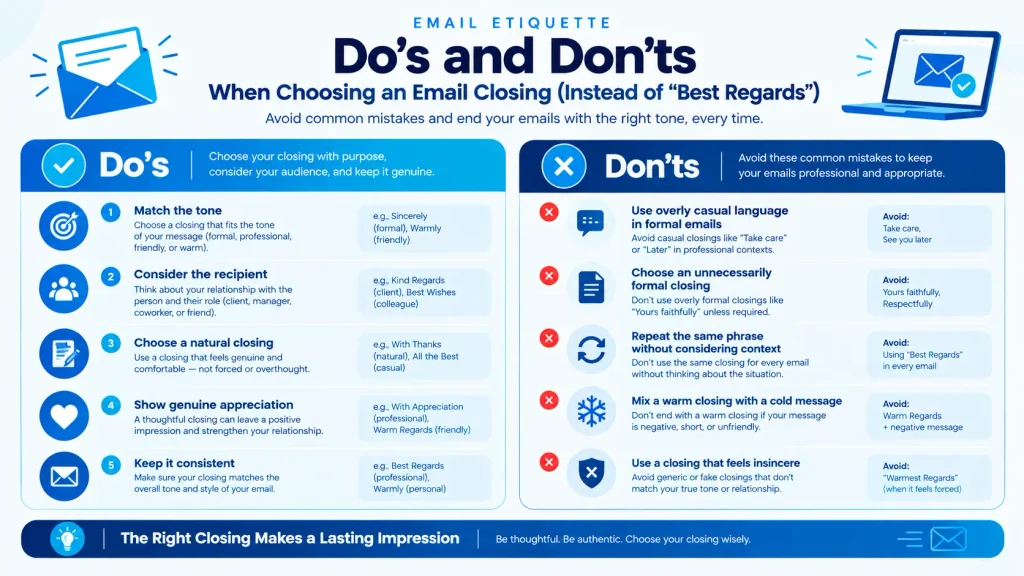
1. Using Casual Phrases in Formal Emails
Closings such as “take care” or “see you” may feel too informal for a client, hiring manager, or senior executive. Choose a closing that matches the professional setting.
2. Choosing Overly Formal Language
A highly formal closing can feel unnatural in a routine workplace email. If you regularly communicate with the recipient, a phrase such as “kind regards” may sound more natural.
3. Repeating the Same Closing
Using “best regards” in every email is not wrong, but it can become repetitive. Having several suitable alternatives gives your communication more variety.
4. Forgetting the Context
Not every closing works equally well in every situation. Consider your relationship with the recipient, the purpose of your message, and the overall tone before choosing a phrase.
5. Sounding Insincere
A warm closing can feel awkward if the rest of the email is extremely formal or distant. Make sure your closing fits the language and attitude used throughout the message.
Frequently Asked Questions
Is “kind regards” better than “best regards”?
“Kind regards” and “best regards” are both widely used professional email closings. Neither is universally better. “Kind regards” can sound slightly more courteous or warm, while “best regards” is a familiar, neutral option. Your relationship with the recipient and the overall tone of the email should guide your choice.
What is a more professional way to say “best regards”?
“Kind regards” is one of the safest professional alternatives to “best regards.” “Sincerely” is another strong choice for formal letters and applications. For a professional message that emphasizes gratitude, “with appreciation” or “with thanks” may be more appropriate.
What is a warmer alternative to “best regards”?
“Warm regards” is a natural warmer alternative to “best regards.” It maintains a professional feel while adding a personal touch. “Warmly” and “best wishes” can also work when you have a friendly relationship with the recipient and the message is not highly formal.
Can I use “all the best” in a professional email?
Yes. “All the best” is appropriate for many professional emails, particularly when you already know the recipient. It sounds friendly and relaxed rather than highly formal. For a first contact, formal request, or sensitive business matter, “kind regards” may better match the context.
Is “best regards” too formal for an email?
No. “Best regards” is generally considered a standard professional closing rather than an excessively formal one. It works in many workplace situations, including emails to colleagues, clients, customers, and business contacts. The rest of your message should still match the level of formality you want to convey.
What can I use instead of “best regards” in a formal letter?
For a formal letter, “sincerely” is a traditional option. Depending on the context, “respectfully” or “cordially” may also work. Choose the closing based on the recipient and purpose rather than using the most formal phrase available.
Can I say “warm regards” to a coworker?
Yes. “Warm regards” can work well with a coworker, especially when you have an established and positive relationship. It adds warmth without becoming overly casual. For a routine internal message, however, “kind regards” or “all the best” may sound more natural.
Should I use a different closing for every email?
You do not need to change your closing every time. Consistency is perfectly acceptable in professional communication. However, having several suitable options can help you match your closing to the purpose of the message, especially when writing formal, appreciative, friendly, or personal emails.
You may also find these guides useful: Another Way to Say Call to Action, Another Way to Say Check Out Our Website and Another Way to Say Customer Service.
Conclusion
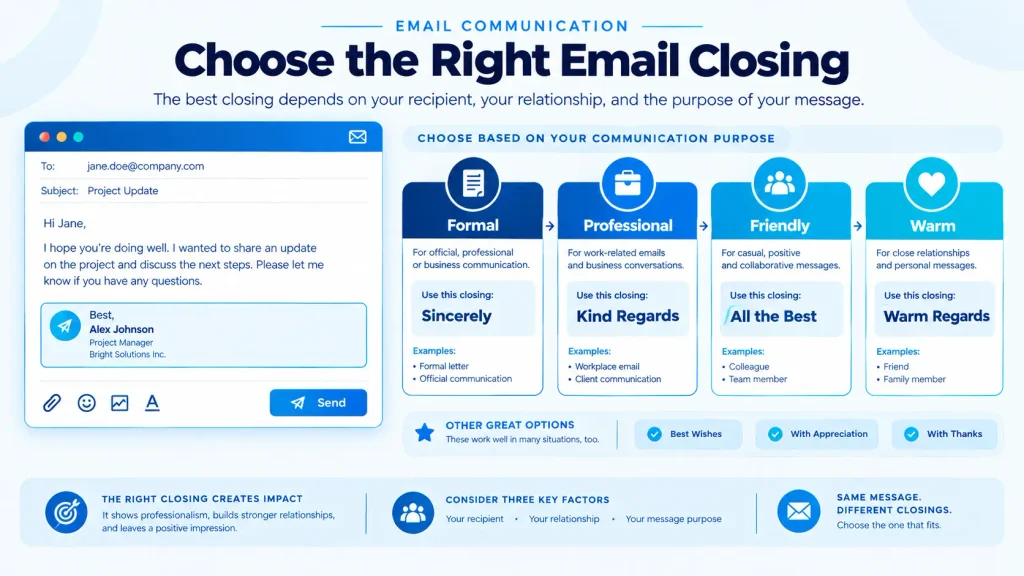
Finding another way to say “best regards” can help you make your emails sound more natural and better suited to each situation. “Kind regards” is a reliable professional choice, while “warm regards” adds a little more friendliness. For formal correspondence, “sincerely” is a traditional option. If your relationship is more familiar, “all the best,” “best wishes,” or “warmly” can create a relaxed and personal tone.
The key is to consider your recipient, relationship, and purpose before choosing an email closing. You do not need a different phrase for every message; you simply need one that feels appropriate and sincere. A well-chosen sign-off can make even a short email feel polished, thoughtful, and complete.
A well-chosen sign-off can make even a short email feel polished, thoughtful, and complete. For a clearer understanding of the phrase, you can also explore the meaning and usage of regards.

The FrontiersPost editorial team writes and reviews every guide to word and phrase alternatives, with clear meanings, tone notes and example sentences for everyday, academic and professional English.




