

Another way to say “mother” depends on the tone and context. Common alternatives include mom, mama, mommy, ma, momma, mother figure, maternal figure, parent, birth mother, and matriarch. In everyday American English, mom is the most natural choice, while the other terms fit specific relationships or situations.
Key Takeaways
- Mom is the most common everyday alternative to “mother” in American English.
- Mama, momma, mommy, and ma can express affection or familiarity.
- Mother figure describes someone who provides motherly care or guidance.
- Parent is a broader, gender-neutral term.
- Birth mother and matriarch have specific meanings and should not be treated as exact synonyms.
The word “mother” can describe a biological parent, an adoptive parent, a woman who provides motherly care, or the female head of a family. The best alternative depends on whether you want to sound casual, affectionate, formal, respectful, or specific.
What Does “Another Way to Say Mother” Mean?
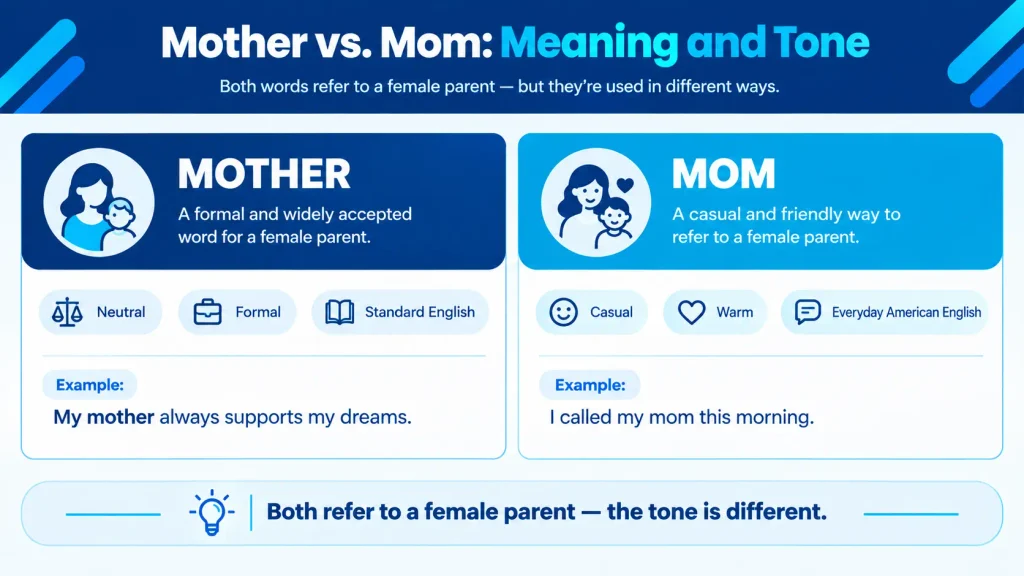
“Another way to say mother” means a different word or phrase that communicates the same or a closely related idea. People often look for alternatives to make their writing sound more natural, avoid repetition, or express a particular relationship or emotion.
In American English, mom is the most common everyday alternative to “mother.” Other choices, such as mama, mommy, ma, or momma, can add warmth or affection, while mother figure and maternal figure describe someone who plays a mother-like role.
You may use different alternatives in family conversations, personal writing, stories, professional contexts, or formal descriptions.
Why Choose a Different Word for Mother?
Choosing a different word for “mother” can make your language more precise and expressive. The right alternative can also show the relationship you have with the person or communicate a specific tone.
Other alternatives can help you:
- Avoid repeating the word “mother.”
- Make everyday conversation sound more natural.
- Express affection or warmth.
- Describe a mother-like relationship more accurately.
- Match formal or informal writing.
- Clarify biological, adoptive, or family roles.
- Add variety to stories, essays, and personal writing.
10 Best Other Ways to Say “Mother”

1. Mom
Meaning
Mom is the most common casual alternative to “mother” in American English. It sounds natural, familiar, and warm, making it the best choice for everyday conversations and personal writing.
Best For
- Casual
- Friendly
- Warm
- Polite
Example 1
“My mom always calls to make sure I got home safely.”
Example 2
“I’m taking my mom out to dinner for her birthday.”
Quick Tip
Use mom in most everyday American English situations. It is generally more natural in conversation than the more formal word “mother.”
2. Mama
Meaning
Mama is a warm and affectionate term for a mother. It is common in family conversations and can sound especially tender when used by children or when talking about a close mother-child relationship.
Best For
- Casual
- Friendly
- Warm
Example 1
“Mama always knew how to make a difficult day feel better.”
Example 2
“The little boy ran across the room and hugged his mama.”
Quick Tip
Choose mama when you want your wording to feel affectionate rather than formal.
3. Mommy
Meaning
Mommy is an affectionate form of “mother” that is especially common among young children. Adults may also use it when speaking nostalgically about childhood or referring to their mother in a playful, loving way.
Best For
- Casual
- Friendly
- Warm
Example 1
“Mommy, can you read me one more story before bed?”
Example 2
“She still remembers how her mommy used to sing to her.”
Quick Tip
Use mommy mainly in contexts involving young children or childhood memories. For most adult conversations, mom sounds more natural.
4. Ma
Meaning
Ma is a short, informal term for “mother.” It can sound familiar and affectionate, although its use varies by family, region, age, and personal preference.
Best For
- Casual
- Friendly
- Warm
Example 1
“Ma, I’ll be home before dinner.”
Example 2
“Thanks, Ma. I really appreciate everything you did for me.”
Quick Tip
Because ma is highly informal, use it when the family relationship and conversational setting make the shortened form appropriate.
5. Momma
Meaning
Momma is an affectionate variation of “mom.” It often carries a strong sense of family closeness and can sound especially warm in personal stories, conversations, and sentimental writing.
Best For
- Casual
- Friendly
- Warm
Example 1
“My momma taught me to treat everyone with kindness.”
Example 2
“She called her momma whenever she needed advice.”
Quick Tip
Use momma when you want a more personal or sentimental tone than the standard word mom.
6. Mother Figure
Meaning
A mother figure is someone who provides care, guidance, support, or protection similar to what a mother might provide. The person does not have to be the speaker’s biological mother.
Best For
- Formal
- Polite
- Warm
Example 1
“My aunt became a mother figure to me after my family moved away.”
Example 2
“Her teacher was an important mother figure during a difficult period in her life.”
Quick Tip
Use mother figure when you are describing a meaningful caregiving relationship rather than identifying someone’s biological relationship.
7. Maternal Figure
Meaning
Maternal figure is a more formal way to describe someone who has qualities or responsibilities traditionally associated with a mother. It is more common in academic, professional, or descriptive writing than in everyday conversation.
Best For
- Formal
- Professional
- Polite
Example 1
“The young athlete viewed her coach as a maternal figure who offered guidance and encouragement.”
Example 2
“The novel introduces a maternal figure who protects the children throughout the story.”
Quick Tip
Use maternal figure in formal or analytical writing. In casual conversation, mother figure usually sounds more natural.
8. Parent
Meaning
Parent is a broader and more neutral term that can refer to a mother or father. It works well when the person’s gender is not important or when you want to discuss a mother’s role from a general parenting perspective.
Best For
- Professional
- Formal
- Polite
Example 1
“Every parent wants to know that their child is safe and supported.”
Example 2
“As a parent, she understands how challenging it can be to balance work and family.”
Quick Tip
Use parent when you want gender-neutral wording or when the specific distinction between mother and father is not relevant.
9. Birth Mother
Meaning
Birth mother specifically refers to the woman who gave birth to a child, particularly when another person has a parental role, such as in adoption. It should not automatically be used as a replacement for “mother” in ordinary situations.
Best For
- Formal
- Polite
Example 1
“The adoption agency helped him learn more about his birth mother.”
Example 2
“She decided to write a letter to her birth mother after many years apart.”
Quick Tip
Use birth mother only when the biological relationship is relevant. In ordinary family conversations, mom or mother is usually more appropriate.
10. Matriarch
Meaning
A matriarch is a woman who is regarded as the head, leader, or influential elder of a family or group. The word can describe a mother, grandmother, or another woman who holds a central position within a family.
Best For
- Formal
- Professional
- Polite
Example 1
“She is the matriarch of a large family with relatives across the country.”
Example 2
“Everyone gathered around the family matriarch during the holiday celebration.”
Quick Tip
Do not use matriarch simply to mean “mother.” It emphasizes leadership, authority, age, or influence within a family or group.
Comparison Table
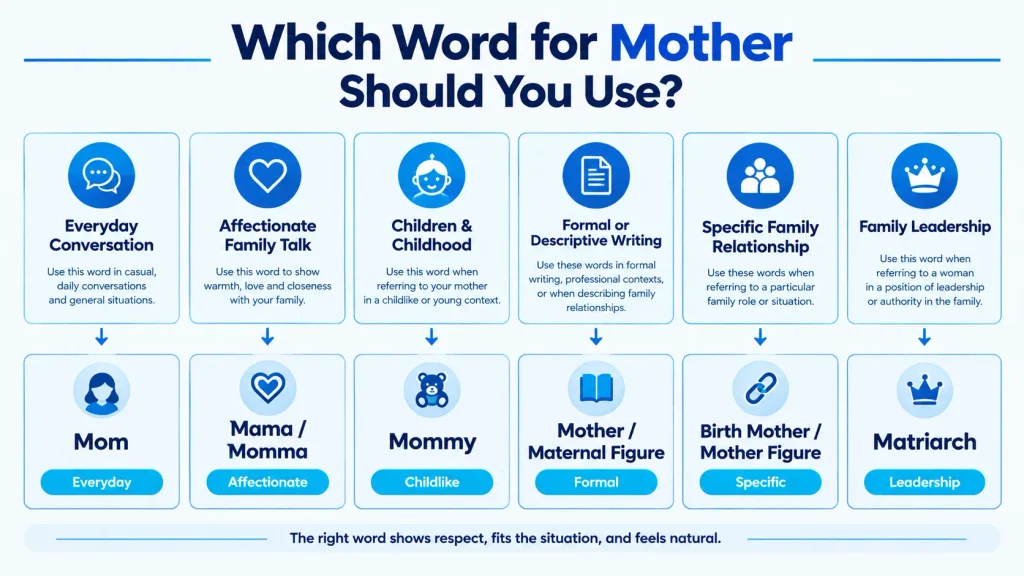
| Alternative | Best Used In | Tone |
|---|---|---|
| Mom | Everyday conversation | Casual, warm |
| Mama | Family and personal conversations | Warm, affectionate |
| Mommy | Childhood and family contexts | Affectionate |
| Ma | Informal family conversations | Casual, familiar |
| Momma | Personal and sentimental contexts | Warm, affectionate |
| Mother figure | Personal and descriptive writing | Warm, respectful |
| Maternal figure | Academic or formal writing | Formal, respectful |
| Parent | General or professional contexts | Neutral, polite |
| Birth mother | Adoption or biological contexts | Specific, respectful |
| Matriarch | Family descriptions and formal writing | Formal, authoritative |
Common Mistakes

1. Using “mommy” in a formal context
“Mommy” is affectionate, but it usually sounds too informal for professional or academic writing. Use mother or parent when a more neutral tone is needed.
2. Treating every alternative as an exact synonym
Some alternatives describe a specific relationship rather than simply replacing “mother.” For example, birth mother refers specifically to the woman who gave birth to a child, while matriarch emphasizes family leadership.
3. Using “maternal figure” in casual conversation
Although grammatically correct, maternal figure can sound academic or clinical in everyday speech. Mother figure is generally more natural when speaking casually.
4. Using “matriarch” for every mother
A mother is not automatically a matriarch. The word suggests that the woman has an important leadership or influential role within a family or group.
5. Choosing a term without considering the relationship
Words such as mama, ma, mommy, and momma can carry personal or cultural associations. Consider how the person normally refers to themselves and what sounds natural in the specific situation.
Frequently Asked Questions

What is another way to say “mother”?
The most common alternative to “mother” in American English is mom. Other choices include mama, mommy, ma, momma, mother figure, maternal figure, parent, birth mother, and matriarch. The best option depends on whether you want a casual, affectionate, formal, neutral, or relationship-specific expression.
What is a casual way to say “mother”?
Mom is the most natural casual way to say “mother” in American English. Depending on the family and situation, you can also use mama, ma, or momma. These alternatives are generally warmer and more conversational than the formal word “mother.”
What is a sweet way to say “mother”?
For a sweet or affectionate tone, mama, momma, or mommy can work well. Mama is particularly natural in warm family conversations, while mommy is more commonly associated with young children or childhood memories. For adults, mama or mom usually sounds more natural.
What is a formal word for “mother”?
In formal writing, mother itself is usually the best choice. Depending on the context, parent can provide a neutral alternative, while maternal figure may work when describing someone who has a mother-like role. Matriarch is appropriate only when the woman is a respected or influential family leader.
Can “parent” be another word for “mother”?
Yes, but parent is a broader term rather than an exact synonym. A parent can be a mother or father, so use it when the person’s gender does not need to be specified. If you specifically mean a female parent, mother or mom provides greater clarity.
What is another word for a mother figure?
Common alternatives include maternal figure and caregiver, depending on the context. A mother figure is someone who provides emotional support, guidance, protection, or care similar to a mother. The person does not have to be the individual’s biological parent.
What is a respectful way to refer to someone’s mother?
Mother is a respectful and neutral choice in most situations. When speaking directly to someone, you can also use the name or title the family normally uses, such as mom or mama. In formal writing, avoid choosing an overly casual term unless you know it is appropriate.
Is “matriarch” the same as “mother”?
Not exactly. A matriarch is a woman who serves as a central leader or influential elder within a family or group. She may be a mother, grandmother, or another relative. The word focuses on her authority or influence rather than simply describing her as a female parent.
You may also find these guides useful: How to Respond to “Thank You for Your Kind Words”, Different Ways to Say Trust Naturally and Clearly and Another Way to Say Deepest Condolences.
Conclusion
There are many ways to say “mother,” but the best choice depends on your relationship with the person and the tone you want to create. For everyday American English, mom is the clearest and most natural option.For everyday American English, mom is the clearest and most natural option.
If you want a warmer expression, mama or momma can add affection, while mommy is more closely associated with children and childhood. For more specific situations, mother figure describes someone who provides motherly care, birth mother identifies a biological relationship, and matriarch emphasizes family leadership.
The key is to choose the word that accurately reflects the relationship and setting. When in doubt, mom for casual conversation and mother for neutral or formal writing are reliable choices.

The FrontiersPost editorial team writes and reviews every guide to word and phrase alternatives, with clear meanings, tone notes and example sentences for everyday, academic and professional English.