
Another way to say interpersonal skills includes people skills, communication skills, social skills, relationship-building skills, human relations skills, and interpersonal abilities. The best choice depends on context. For a resume or professional setting, “people skills” or “relationship-building skills” can sound natural, while “social skills” works well in everyday communication.
Key Takeaways
- “People skills” is one of the most natural alternatives to “interpersonal skills.”
- “Communication skills” is useful when the focus is on speaking, listening, or exchanging information.
- “Relationship-building skills” emphasizes creating and maintaining positive relationships.
- “Social skills” works well in casual, educational, and everyday contexts.
- Choose an alternative based on the specific skill or situation you want to describe.
What Does “Another Way to Say Interpersonal Skills” Mean?
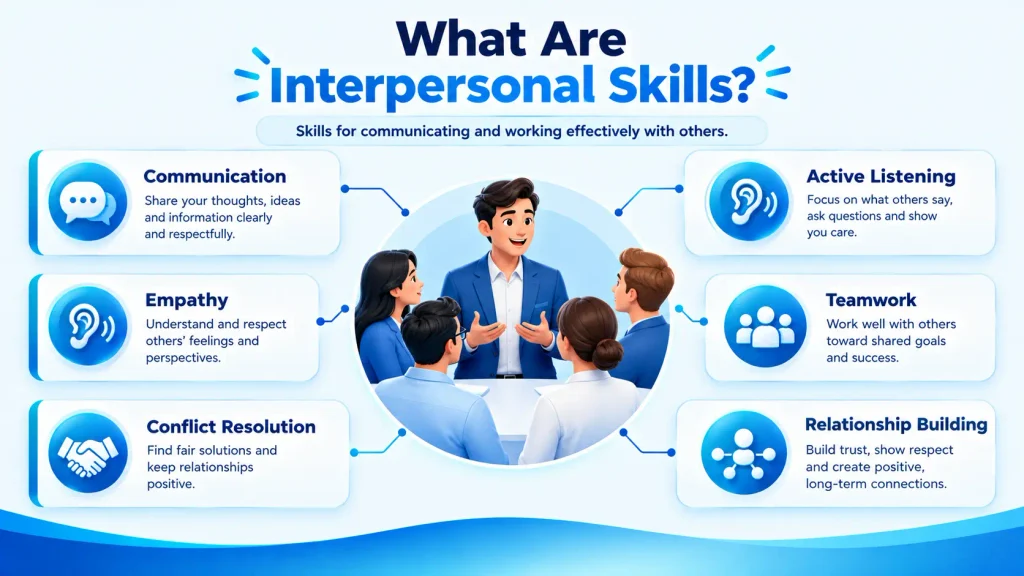
The phrase “another way to say interpersonal skills” refers to different words or expressions that describe a person’s ability to communicate, cooperate, connect, and work effectively with others.
Interpersonal skills include abilities such as listening, empathy, teamwork, communication, conflict resolution, and relationship building. You may want an alternative when writing a resume, cover letter, essay, performance review, or professional profile.
These alternatives help you be more specific instead of using the same phrase repeatedly. For example, “relationship-building skills” highlights connections with others, while “communication skills” focuses more directly on exchanging ideas and information.
Why Use Other Ways to Say “Interpersonal Skills”?
Using alternative expressions can make your writing clearer, more natural, and better suited to your audience.
Consider another phrase when you want to:
- Avoid repeating “interpersonal skills.”
- Make a resume sound more specific.
- Describe a particular social or communication ability.
- Match the tone of a professional or academic document.
- Explain your strengths in everyday language.
- Show how you work with colleagues, clients, or teams.
The key is to choose a phrase that accurately describes the skill you mean rather than treating every alternative as an exact synonym.
10 Best Other Ways to Say “Interpersonal Skills”
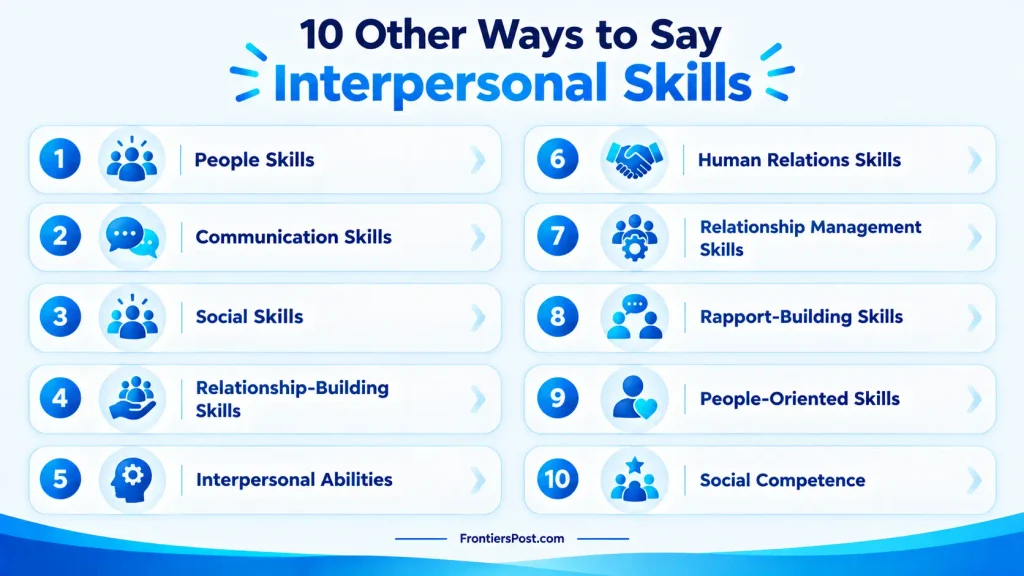
1. People Skills
Meaning
People skills is a natural and widely understood alternative to “interpersonal skills.” It describes the ability to communicate, cooperate, understand others, and build positive relationships.
Best For
- Professional
- Casual
- Friendly
Example 1
Her strong people skills help her work effectively with customers from different backgrounds.
Example 2
The manager is known for excellent people skills and a calm approach to difficult conversations.
Quick Tip
Use “people skills” when you want a straightforward phrase that sounds less technical than “interpersonal skills.”
2. Communication Skills
Meaning
Communication skills refers to the ability to express ideas clearly and understand information from others. It can include speaking, writing, listening, and nonverbal communication.
Best For
- Professional
- Formal
- Academic
Example 1
Strong communication skills are essential for working with clients and meeting project goals.
Example 2
The position requires excellent communication skills and careful attention to detail.
Quick Tip
Choose this phrase when communication itself is the main ability you want to emphasize.
3. Social Skills
Meaning
Social skills describe the abilities people use when interacting with others. They can include conversation, listening, cooperation, understanding social cues, and responding appropriately.
Best For
- Casual
- Friendly
- Professional
Example 1
Good social skills can make it easier to start conversations with new colleagues.
Example 2
The program helps students develop social skills through group activities and discussions.
Quick Tip
“Social skills” is especially useful when discussing everyday interactions, education, or personal development.
4. Relationship-Building Skills
Meaning
Relationship-building skills emphasize the ability to establish trust and maintain positive connections with other people. This expression is especially relevant when relationships are important to professional success.
Best For
- Professional
- Formal
- Warm
Example 1
Her relationship-building skills have helped the company develop long-term partnerships.
Example 2
Sales professionals often rely on relationship-building skills to earn customer trust.
Quick Tip
Use this phrase when you want to highlight trust, connection, and long-term professional relationships.
5. Interpersonal Abilities
Meaning
Interpersonal abilities is a close alternative to “interpersonal skills” and carries nearly the same meaning. It focuses on a person’s capacity to communicate and interact effectively with others.
Best For
- Formal
- Professional
- Academic
Example 1
His interpersonal abilities allow him to collaborate successfully with people across multiple departments.
Example 2
The internship provides opportunities to strengthen interpersonal abilities through teamwork.
Quick Tip
This option works well when you want to maintain a formal tone without changing the original meaning too much.
6. Human Relations Skills
Meaning
Human relations skills refer to the ability to interact positively and productively with other people. The phrase often emphasizes cooperation, understanding, respect, and workplace relationships.
Best For
- Professional
- Formal
Example 1
Effective human relations skills can help supervisors create a respectful workplace.
Example 2
The training focuses on leadership, teamwork, and human relations skills.
Quick Tip
This phrase is most appropriate in workplace, management, training, and organizational contexts.
7. Relationship Management Skills
Meaning
Relationship management skills describe the ability to maintain productive relationships with people. They can involve communication, trust, conflict management, empathy, and consistent follow-through.
Best For
- Professional
- Formal
Example 1
The account manager uses strong relationship management skills to support key clients.
Example 2
Successful leaders often need relationship management skills when handling competing priorities.
Quick Tip
Use this expression when discussing clients, leadership, partnerships, or other ongoing professional relationships.
8. Rapport-Building Skills
Meaning
Rapport-building skills focus on creating a sense of trust, comfort, and mutual understanding with another person. They are particularly useful when positive connections need to develop quickly.
Best For
- Professional
- Formal
- Friendly
Example 1
The counselor uses strong rapport-building skills to make new clients feel comfortable.
Example 2
Good rapport-building skills can help sales representatives establish trust during their first meeting.
Quick Tip
This phrase is ideal when the ability to create trust and a comfortable connection is the main point.
9. People-Oriented Skills
Meaning
People-oriented skills describe abilities that help someone work effectively with, understand, and support other people. The phrase can suggest an interest in collaboration and human interaction.
Best For
- Professional
- Friendly
- Warm
Example 1
The position requires strong people-oriented skills because employees interact with customers throughout the day.
Example 2
Her people-oriented skills make her an effective mentor and team leader.
Quick Tip
Use this expression when describing someone who works closely with people and values positive interaction.
10. Social Competence
Meaning
Social competence refers to the ability to interact appropriately and effectively with other people in different situations. It can include communication, cooperation, emotional awareness, and adapting to social settings.
Best For
- Formal
- Academic
- Professional
Example 1
The study examined how classroom activities can support children’s social competence.
Example 2
Strong social competence can help employees navigate challenging workplace interactions.
Quick Tip
“Social competence” is particularly suitable for academic, educational, psychological, and professional discussions.
Comparison Table
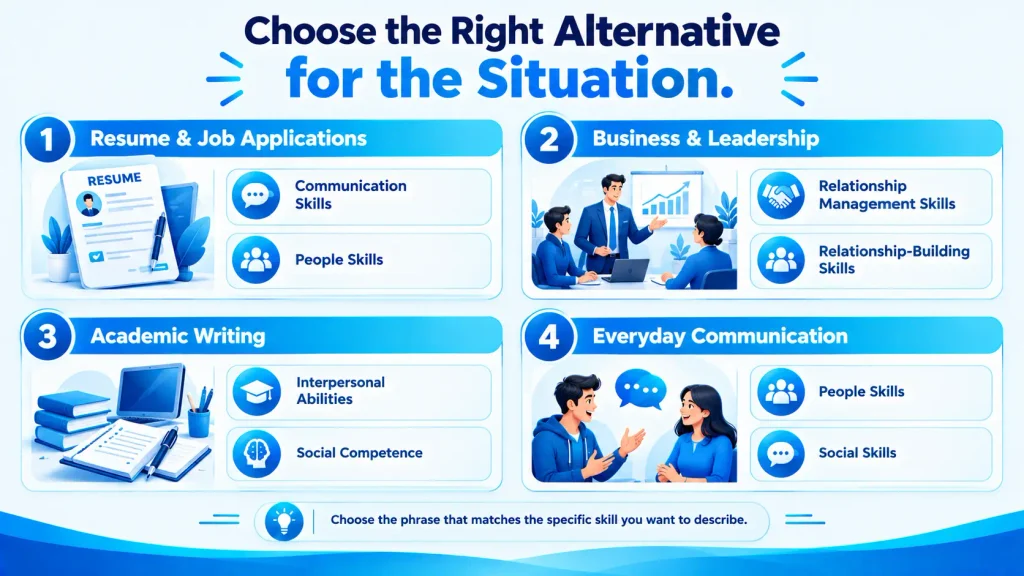
| Alternative | Best Used In | Tone |
| People skills | Workplace, resumes, everyday communication | Natural |
| Communication skills | Resumes, jobs, academic writing | Professional |
| Social skills | Education, everyday interaction | Casual |
| Relationship-building skills | Business, sales, leadership | Professional |
| Interpersonal abilities | Academic and professional writing | Formal |
| Human relations skills | Management and workplace training | Formal |
| Relationship management skills | Business, leadership, client work | Professional |
| Rapport-building skills | Counseling, sales, customer service | Professional |
| People-oriented skills | Workplace profiles and descriptions | Warm |
| Social competence | Academic and educational writing | Formal |
Common Mistakes
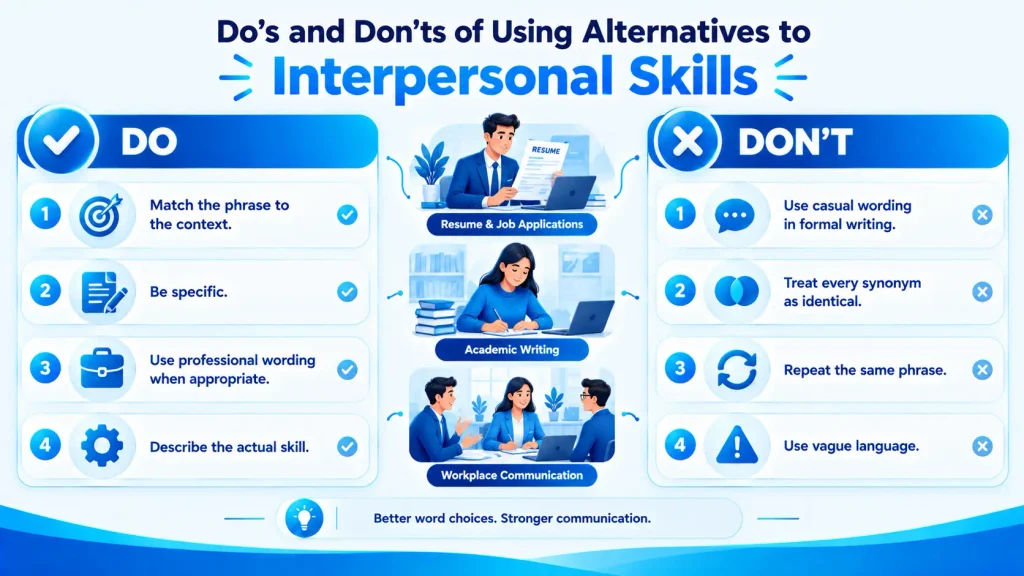
1. Using a Casual Phrase in a Formal Document
Phrases such as “people skills” may sound natural, but some academic or highly formal documents may require more precise terminology. Match the expression to your audience and purpose.
2. Treating Every Alternative as an Exact Synonym
Not every alternative has exactly the same meaning. For example, communication skills focus heavily on exchanging information, while relationship-building skills emphasize creating lasting connections.
3. Repeating “Interpersonal Skills” Too Often
Repeating the same phrase can make an article, resume, or professional profile sound monotonous. Use relevant alternatives when they accurately describe different aspects of your abilities.
4. Ignoring Context
A phrase that works well on a resume may not be the best choice in an academic paper. Consider whether you are discussing teamwork, communication, customer relationships, leadership, or general social interaction.
5. Using Vague Language
Simply saying that someone has “good interpersonal skills” may not explain what they actually do well. When possible, describe the specific ability, such as active listening, conflict resolution, collaboration, or relationship building.
Frequently Asked Questions
What is another way to say interpersonal skills on a resume?
“People skills,” “communication skills,” “relationship-building skills,” and “relationship management skills” can work well on a resume. The best option depends on the position. For example, communication skills may suit an administrative role, while relationship management skills may be more relevant to sales, account management, or leadership.
What is a professional synonym for interpersonal skills?
Professional alternatives include “interpersonal abilities,” “communication skills,” “relationship-building skills,” and “relationship management skills.” These phrases can make a professional profile more specific. Choose the one that reflects the actual ability you want to highlight rather than replacing the original phrase simply for variety.
What is a simple way to say interpersonal skills?
“People skills” is one of the simplest and most natural ways to say “interpersonal skills.” It is easy to understand and works in many everyday and workplace situations. However, “communication skills” may be clearer when you specifically mean speaking, listening, writing, or sharing information.
Are communication skills and interpersonal skills the same?
They overlap, but they are not exactly the same. Communication skills focus on how effectively a person exchanges information, while interpersonal skills cover a broader range of interactions, including communication, teamwork, empathy, cooperation, conflict resolution, and relationship building.
What can I say instead of interpersonal skills in an essay?
In an essay, you can use terms such as “interpersonal abilities,” “social competence,” or “communication abilities,” depending on the subject. Academic writing benefits from precise wording, so select an expression that describes the specific behavior or ability being discussed.
What is another way to describe good interpersonal skills?
You can describe them as strong people skills, effective communication abilities, strong relationship-building abilities, or effective social skills. You can also be more specific by mentioning active listening, teamwork, empathy, conflict resolution, or the ability to build trust.
What are interpersonal skills in simple words?
Interpersonal skills are the abilities people use to interact and work effectively with others. They include listening, communicating clearly, cooperating, showing empathy, resolving disagreements, and building positive relationships. These skills are useful in workplaces, schools, communities, and personal relationships.
Which phrase is best for a job application?
The best phrase depends on the job. “Communication skills” works well for roles that involve frequent information exchange, while “relationship-building skills” suits positions involving clients or partnerships. For leadership roles, “relationship management skills” may more clearly describe the ability to maintain productive professional relationships.
Conclusion
There are many useful ways to say interpersonal skills, but the right choice depends on what you want to communicate. People skills offers a simple, natural alternative, while communication skills focuses specifically on exchanging information. For professional relationships, relationship-building skills and relationship management skills provide greater detail.
In academic or formal writing, interpersonal abilities and social competence can fit more naturally. Meanwhile, rapport-building skills works well when trust and connection are central to the situation.
Instead of replacing the phrase just to avoid repetition, choose an alternative that accurately describes the ability you mean. A specific phrase will make your resume, essay, profile, or professional communication clearer and more effective. For a clearer definition, you can also review the meaning of interpersonal skills in the Cambridge Dictionary.

Sarah Mitchell is a Senior English Editor at FrontiersPost, specializing in English usage, vocabulary, word choice, grammar, and effective communication. She focuses on helping readers understand subtle differences between commonly confused words, phrases, and expressions and use them naturally in everyday, professional, and academic writing.
At FrontiersPost, Sarah researches, writes, and edits educational content with an emphasis on clarity, accuracy, and practical examples. She works closely with the editorial team to ensure that articles are easy to understand while maintaining appropriate context, meaning, and usage.
Her editorial interests include English vocabulary, synonyms, phrasing, professional communication, and the practical nuances that can make written communication more precise and effective.