

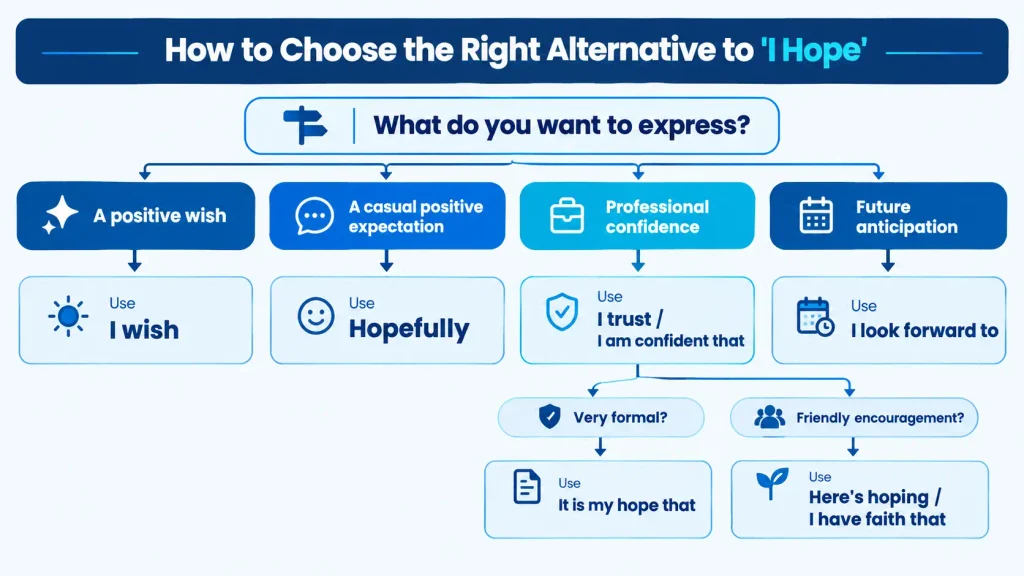
If you are looking for another way to say “I hope,” you can use phrases such as “I wish,” “hopefully,” “I trust,” “I look forward to,” or “here’s hoping.” The best choice depends on your context, tone, and level of certainty. Professional writing often calls for “I trust,” while casual conversations may suit “here’s hoping.”
Key Takeaways
- “I hope” expresses a wish, expectation, or positive possibility.
- “I wish” works well for personal hopes and sincere expressions.
- “I trust” is useful in professional and business communication.
- “Hopefully” is concise and natural in everyday English.
- Choose your alternative based on tone, context, and how certain you feel.
“I hope” is one of the most common phrases in American English. It can express a positive wish, expectation, desire, or belief about something that may happen.
Although “I hope” is perfectly natural, repeating it can make your writing sound predictable. Using a suitable alternative can help you sound more precise, warm, professional, or conversational.
What Does “Another Way to Say I Hope” Mean?
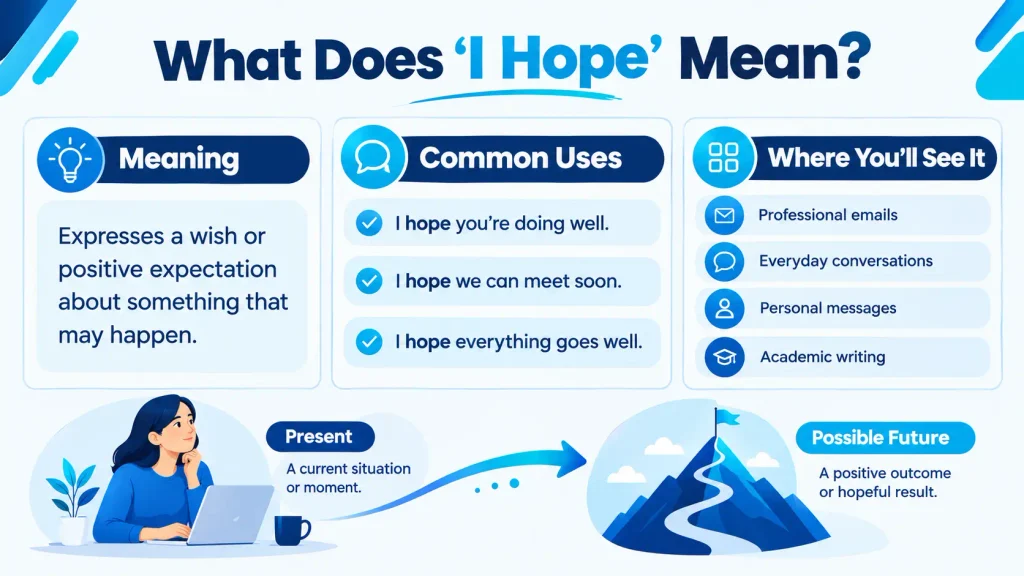
Looking for another way to say “I hope” means finding a different expression that communicates a similar idea. Depending on the sentence, you may be expressing a wish, optimism, expectation, confidence, or polite anticipation.
For example, “I hope you have a great weekend” can become “I wish you a great weekend” or “Hopefully, you have a great weekend.” In a professional email, “I trust you are doing well” may sound more appropriate.
People commonly use alternatives to “I hope” in emails, conversations, greeting cards, workplace messages, academic writing, and personal communication.
Why Use Other Ways to Say “I Hope”?
Using different expressions can make your communication more natural and specific. The right alternative can also help you match the relationship and situation.
- Avoid repeating the same phrase.
- Make professional emails sound more polished.
- Express warmth or emotion more naturally.
- Show optimism without sounding repetitive.
- Match formal, casual, friendly, or polite situations.
- Communicate expectations with greater precision.
10 Best Other Ways to Say “I Hope”
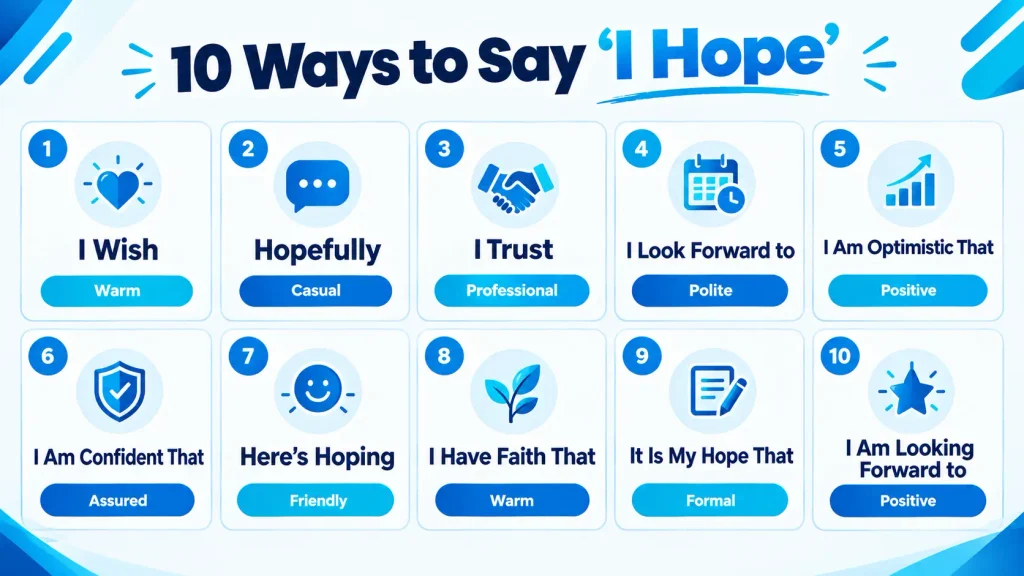
1. I Wish
Meaning
“I wish” expresses a sincere desire for something positive to happen. It can sound warm and personal, especially when offering good wishes.
Best For
- Friendly
- Warm
- Personal
- Polite
Example 1
I wish you a safe and enjoyable trip to California.
Example 2
I wish you every success in your new position.
Quick Tip
Use “I wish” when your sentence focuses on sending someone a positive thought or good wishes.
2. Hopefully
Meaning
“Hopefully” expresses a positive expectation or desired outcome. It is shorter and more conversational than “I hope.”
Best For
- Casual
- Friendly
- Professional
- Polite
Example 1
Hopefully, the weather will clear up before the game.
Example 2
Hopefully, we can finish the project by Friday.
Quick Tip
“Hopefully” works especially well when the subject is understood from the context.
3. I Trust
Meaning
“I trust” communicates confidence that something is true or will happen. It is especially useful when you want to sound courteous and professional.
Best For
- Professional
- Formal
- Polite
Example 1
I trust you received the documents I sent yesterday.
Example 2
I trust everything is going smoothly with the new account.
Quick Tip
Use “I trust” in business emails when you want a polished alternative to “I hope.”
4. I Look Forward to
Meaning
“I look forward to” expresses positive anticipation about a future event or action. It is more specific than “I hope” because it focuses on something you expect or anticipate.
Best For
- Professional
- Formal
- Polite
Example 1
I look forward to meeting you at the conference next month.
Example 2
I look forward to hearing your thoughts on the proposal.
Quick Tip
Follow “I look forward to” with a noun or an -ing verb, such as “hearing” rather than “hear.”
5. I Am Optimistic That
Meaning
“I am optimistic that” shows a positive belief about a future result. It communicates more confidence than a simple expression of hope.
Best For
- Professional
- Formal
Example 1
I am optimistic that the team will meet its quarterly goals.
Example 2
I am optimistic that these changes will improve customer satisfaction.
Quick Tip
Choose this phrase when you want to emphasize a positive expectation rather than simply express a wish.
6. I Am Confident That
Meaning
“I am confident that” indicates a strong belief that something will happen or prove successful. It sounds more certain than “I hope.”
Best For
- Professional
- Formal
Example 1
I am confident that our revised plan will address the main concerns.
Example 2
I am confident that she will handle the presentation successfully.
Quick Tip
Do not use this phrase when you genuinely feel uncertain; “I hope” may be more accurate in that situation.
7. Here’s Hoping
Meaning
“Here’s hoping” is a relaxed expression used to show optimism about a desired outcome. It has a friendly, conversational feel.
Best For
- Casual
- Friendly
- Warm
Example 1
Here’s hoping you get some much-needed rest this weekend.
Example 2
Here’s hoping the team brings home a win tonight.
Quick Tip
Save “here’s hoping” for informal messages and conversations rather than formal business correspondence.
8. I Have Faith That
Meaning
“I have faith that” expresses strong belief in a person, situation, or future outcome. It can communicate encouragement and emotional support.
Best For
- Warm
- Friendly
- Personal
Example 1
I have faith that you will make the right decision.
Example 2
I have faith that things will work out for your family.
Quick Tip
This phrase is most natural when you genuinely want to reassure or encourage someone.
9. It Is My Hope That
Meaning
“It is my hope that” is a formal way to express a desired outcome. It sounds more deliberate and serious than the everyday phrase “I hope.”
Best For
- Formal
- Professional
- Polite
Example 1
It is my hope that this program will benefit students across the district.
Example 2
It is my hope that we can find a solution that works for everyone.
Quick Tip
Use this expression sparingly because its formal tone can sound too serious in casual conversation.
10. I Am Looking Forward to
Meaning
“I am looking forward to” expresses excitement or positive anticipation about something expected in the future. It is common in both professional and personal communication.
Best For
- Professional
- Friendly
- Warm
- Polite
Example 1
I am looking forward to spending time with everyone during the holiday.
Example 2
I am looking forward to starting my new role next week.
Quick Tip
Use this phrase when the future event is expected to happen, not simply something you wish might happen.
Comparison Table
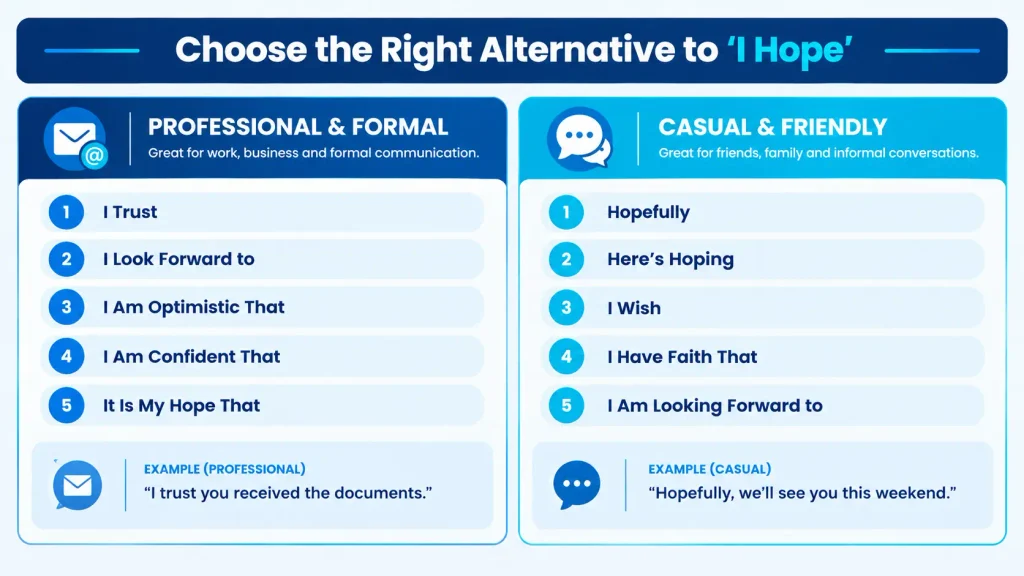
| Alternative | Best Used In | Tone |
| I wish | Personal messages | Warm |
| Hopefully | Everyday communication | Casual |
| I trust | Business emails | Professional |
| I look forward to | Work and formal emails | Polite |
| I am optimistic that | Professional writing | Positive |
| I am confident that | Business communication | Assured |
| Here’s hoping | Casual conversations | Friendly |
| I have faith that | Encouragement | Warm |
| It is my hope that | Formal writing | Formal |
| I am looking forward to | Personal or professional messages | Positive |
Common Mistakes
- Using casual phrases in professional emails: “Here’s hoping” may sound too relaxed for a formal business message.
- Choosing overly formal language: “It is my hope that” can feel stiff in an everyday text.
- Changing the level of certainty: “I am confident that” sounds much more certain than “I hope.”
- Ignoring the context: A phrase that works with a friend may not fit an academic or workplace message.
- Sounding insincere: Choose an expression that reflects what you genuinely mean rather than using a phrase simply because it sounds polished.
Frequently Asked Questions
What is another way to say “I hope” professionally?
Professional alternatives include “I trust,” “I look forward to,” “I am optimistic that,” and “I am confident that.” Your choice depends on the meaning. “I trust” is useful for polite business statements, while “I look forward to” works well when anticipating a specific event or response.
What is a better word for “I hope”?
There is no single replacement that works in every sentence. “Hopefully” is a concise option, while “I wish” expresses a personal desire. In professional writing, “I trust” or “I look forward to” may sound more natural depending on the context.
How can I say “I hope you are doing well” differently?
You can say “I trust you are doing well,” “I hope everything is going well for you,” or “I trust all is well.” For a more casual message, “Hope everything’s going well” is natural and friendly.
What is another way to say “I hope this email finds you well”?
You can replace it with “I trust you are doing well,” “I hope you’re having a good week,” or simply begin with the purpose of your email. In many professional emails, getting directly to the main point can sound clearer and more natural.
Is “I wish” the same as “I hope”?
“I wish” and “I hope” can both express positive desires, but they are not always interchangeable. “I hope” often refers to something that may realistically happen, while “I wish” can express a broader desire or something less certain.
Is “hopefully” formal or informal?
“Hopefully” is acceptable in both everyday and professional English when used naturally. It is generally less formal than phrases such as “It is my hope that,” but it is common in modern American communication.
What can I say instead of “I hope” in an email?
For a professional email, consider “I trust,” “I look forward to,” or “I am optimistic that.” The best option depends on your intended meaning. For example, use “I look forward to hearing from you” when you expect a response.
How can I say “I hope everything works out” differently?
You could say “I trust everything will work out,” “I am optimistic that things will work out,” or “Here’s hoping everything works out.” Choose the phrase based on your relationship with the reader and how formal the situation is.
Writing something similar? Try Another Way to Say In a Way, Another Way to Say “Life-Changing” to Describe a Powerful Experience or Another Way to Say Mental Health.
Conclusion
There are many natural ways to say “I hope,” but the best alternative depends on what you want to communicate. For a clearer understanding of the meaning and use of hope.
When you are anticipating a specific event, “I look forward to” is often more precise. If you want to show strong belief, “I am confident that” works better, while “here’s hoping” keeps the tone relaxed and friendly.
The key is not simply to replace “I hope” with another phrase. Choose wording that matches your meaning, relationship, and level of certainty. A thoughtful alternative can make even a short sentence sound more natural and intentional.

The FrontiersPost editorial team writes and reviews every guide to word and phrase alternatives, with clear meanings, tone notes and example sentences for everyday, academic and professional English.




