

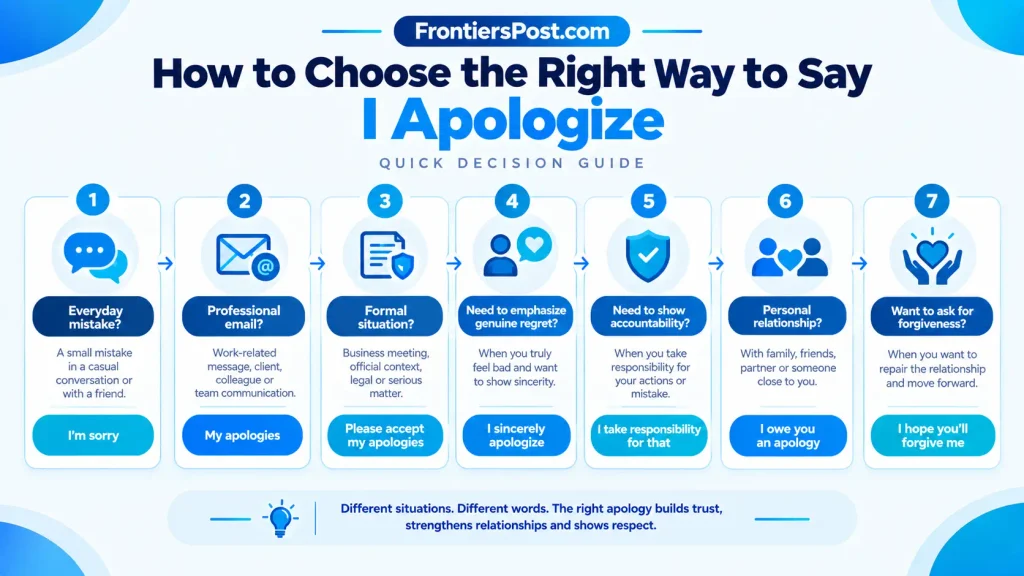
If you’re looking for another way to say I apologize, you can choose from phrases such as “I’m sorry,” “My apologies,” “Please accept my apologies,” and “I regret my mistake.” The best choice depends on the situation, your relationship with the person, and how formal or sincere you want your apology to sound.
Key Takeaways
- “I’m sorry” is the most natural choice for everyday apologies.
- “My apologies” works well in professional emails and messages.
- “Please accept my apologies” is more formal and respectful.
- “I sincerely apologize” emphasizes genuine regret.
- Choose an apology based on the seriousness of the situation and your relationship with the other person.
What Does “Another Way to Say I Apologize” Mean?
The phrase “another way to say I apologize” refers to alternative expressions you can use when you want to admit a mistake, express regret, or ask someone to forgive you.
“I apologize” is polite and appropriate in many situations, especially at work. However, using the same phrase repeatedly can make your communication sound predictable, so alternatives can help you express the right tone.
You might use a different apology in a professional email, a conversation with a friend, a serious mistake, or a situation where you want to take responsibility.
Why Use Other Ways to Say “I Apologize”?
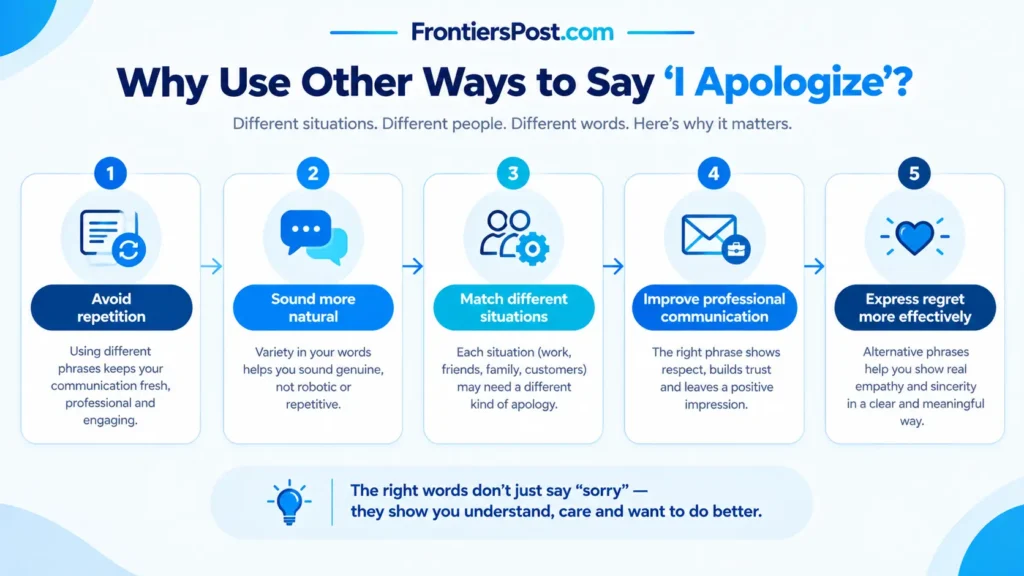
Choosing a different way to apologize can make your message sound more natural and appropriate for the situation.
Using the right expression can help you:
- Avoid repeating “I apologize.”
- Sound more natural in everyday conversations.
- Show genuine regret.
- Match a professional or formal situation.
- Take responsibility for a mistake.
- Make an apology feel warmer and more personal.
The key is to choose an expression that matches both the situation and the level of regret you want to communicate.
10 Best Other Ways to Say “I Apologize”
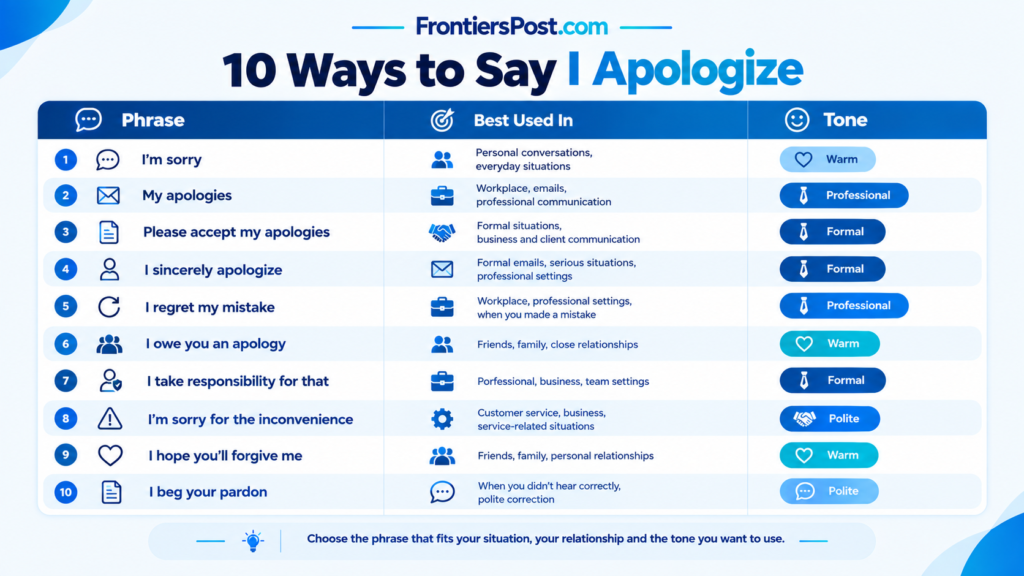
1. I’m Sorry
Meaning
“I’m sorry” is one of the most common and natural ways to apologize in American English. It can express regret for anything from a small mistake to something more serious.
Best For
- Casual
- Friendly
- Warm
- Professional
- Polite
Example 1
I’m sorry I missed your call earlier; I was in a meeting.
Example 2
I’m sorry for the confusion, and I appreciate your patience.
Quick Tip
Use “I’m sorry” when you want your apology to sound sincere without being overly formal.
2. My Apologies
Meaning
“My apologies” is a concise and polite alternative to “I apologize.” It is especially common in professional emails when you need to acknowledge a mistake, delay, or inconvenience.
Best For
- Professional
- Formal
- Polite
Example 1
My apologies for the delayed response.
Example 2
My apologies for sending the wrong attachment.
Quick Tip
This phrase is useful when you want to apologize professionally without making the message overly emotional.
3. Please Accept My Apologies
Meaning
“Please accept my apologies” is a formal way to express sincere regret. It works best when the situation is important enough to require a respectful and carefully worded apology.
Best For
- Formal
- Professional
- Polite
Example 1
Please accept my apologies for the inconvenience caused by the scheduling change.
Example 2
Please accept my apologies for the error in the report.
Quick Tip
Reserve this expression for more formal situations because it can sound too serious for a minor everyday mistake.
4. I Sincerely Apologize
Meaning
“I sincerely apologize” emphasizes that your apology is genuine. It is useful when you want to make clear that you recognize the impact of your actions and truly regret them.
Best For
- Formal
- Professional
- Warm
- Polite
Example 1
I sincerely apologize for the misunderstanding and any problems it caused.
Example 2
I sincerely apologize for failing to communicate the change sooner.
Quick Tip
Adding “sincerely” makes the apology stronger, so use it when genuine regret matters.
5. I Regret My Mistake
Meaning
“I regret my mistake” directly acknowledges that you made an error. It sounds thoughtful and responsible, particularly when you want to focus on recognizing what went wrong.
Best For
- Formal
- Professional
- Polite
Example 1
I regret my mistake and will make sure the information is corrected.
Example 2
I regret my mistake and understand why it caused frustration.
Quick Tip
This phrase works well when you want to pair your apology with a commitment to correct the problem.
6. I Owe You an Apology
Meaning
“I owe you an apology” acknowledges that someone deserves an apology from you. It can sound personal and sincere because it directly recognizes your responsibility.
Best For
- Friendly
- Warm
- Casual
- Polite
Example 1
I owe you an apology for how I handled that conversation.
Example 2
I owe you an apology for assuming I knew what happened.
Quick Tip
Use this phrase when you want your apology to feel personal rather than scripted.
7. I Take Responsibility for That
Meaning
“I take responsibility for that” focuses on accountability rather than simply expressing regret. It is especially useful when your actions clearly contributed to a problem.
Best For
- Professional
- Formal
- Polite
Example 1
I take responsibility for that oversight and will correct the report today.
Example 2
I take responsibility for the scheduling error and understand the inconvenience it caused.
Quick Tip
This expression is strongest when followed by a clear action you will take to fix the situation.
8. I’m Sorry for the Inconvenience
Meaning
“I’m sorry for the inconvenience” is commonly used when your actions, a delay, or an unexpected problem has caused trouble for someone else. It is particularly useful in customer service and workplace communication.
Best For
- Professional
- Polite
- Formal
Example 1
I’m sorry for the inconvenience caused by the last-minute change.
Example 2
I’m sorry for the inconvenience while we work to resolve the issue.
Quick Tip
Use this phrase when the main concern is the trouble or disruption someone experienced.
9. I Hope You’ll Forgive Me
Meaning
“I hope you’ll forgive me” is a more personal expression that directly acknowledges the other person’s feelings. It can sound warm and sincere when the relationship matters to you.
Best For
- Warm
- Friendly
- Casual
- Polite
Example 1
I hope you’ll forgive me for forgetting such an important date.
Example 2
I hope you’ll forgive me for not being there when you needed me.
Quick Tip
This phrase is better suited to personal relationships than routine workplace apologies.
10. I Beg Your Pardon
Meaning
“I beg your pardon” is a traditional and highly polite expression. Depending on context, it can be used as an apology for a minor offense or to politely ask someone to repeat something.
Best For
- Formal
- Polite
- Professional
Example 1
I beg your pardon for interrupting the discussion.
Example 2
I beg your pardon; I misunderstood your question.
Quick Tip
Use this carefully because it can sound formal or old-fashioned in casual American English.
Comparison Table
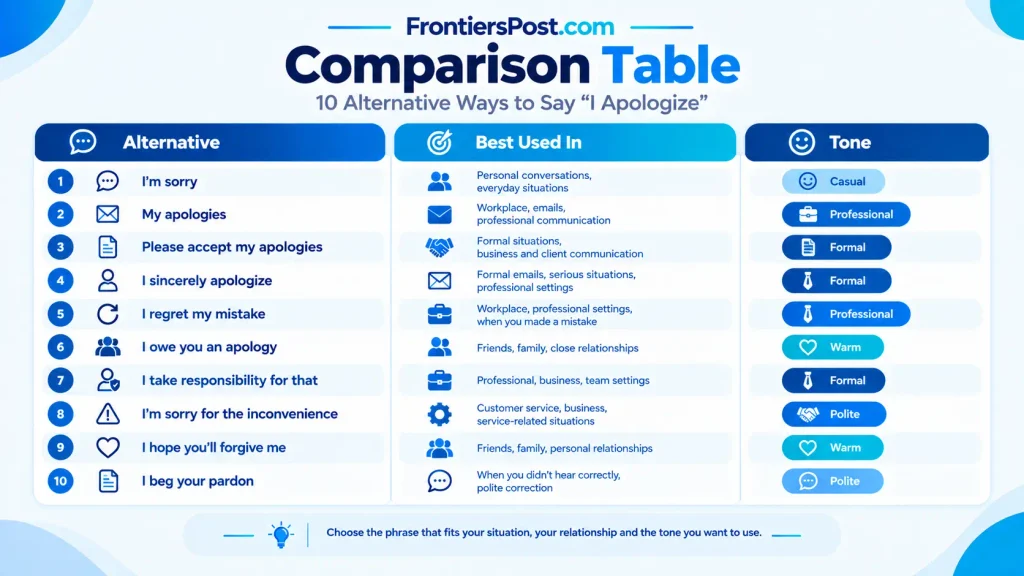
| Alternative | Best Used In | Tone |
| I’m sorry | Everyday conversations, work | Warm, natural |
| My apologies | Emails, workplace communication | Professional, polite |
| Please accept my apologies | Formal situations | Formal, respectful |
| I sincerely apologize | Serious or important situations | Sincere, formal |
| I regret my mistake | Workplace or serious errors | Responsible, formal |
| I owe you an apology | Personal conversations | Warm, sincere |
| I take responsibility for that | Workplace mistakes | Accountable, professional |
| I’m sorry for the inconvenience | Customer service, work | Polite, professional |
| I hope you’ll forgive me | Personal relationships | Warm, personal |
| I beg your pardon | Formal or polite situations | Formal, respectful |
Common Mistakes
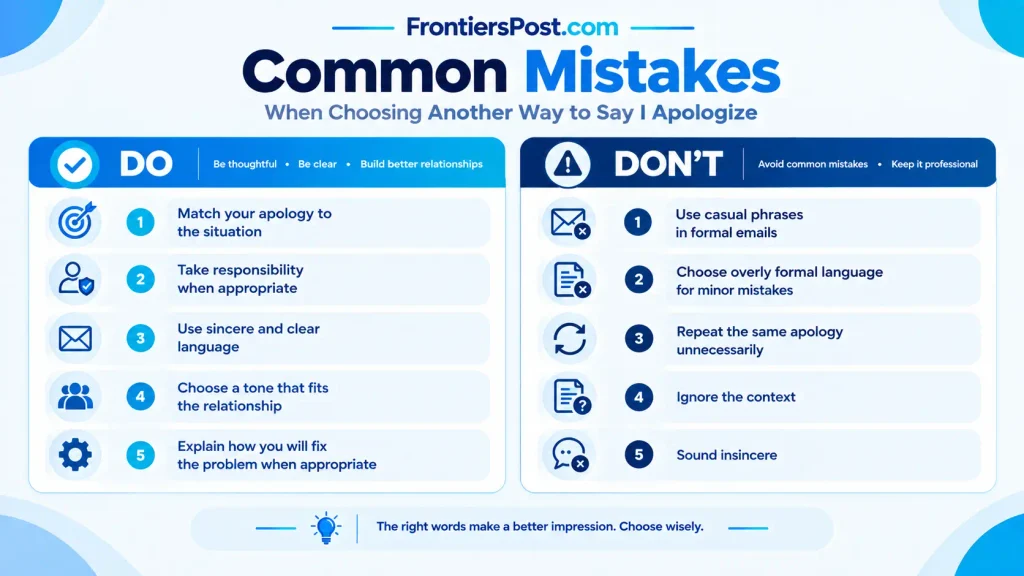
1. Using Casual Phrases in Professional Emails
A phrase that works with a close friend may sound too informal at work. Choose professional wording when communicating with a manager, client, customer, or colleague.
2. Choosing Overly Formal Language
Not every situation requires “Please accept my apologies.” For a small everyday mistake, “I’m sorry” often sounds more natural.
3. Repeating the Same Apology
Repeating “I apologize” several times can make your communication sound mechanical. Choose an alternative that reflects the specific situation instead.
4. Forgetting the Context
An apology should match the relationship and seriousness of the mistake. A warm personal phrase may not fit a formal business email, while highly formal language can feel distant between friends.
5. Sounding Insincere
An apology is more effective when it recognizes what went wrong. When appropriate, briefly explain how you will correct the problem instead of relying on an apology alone.
Frequently Asked Questions
What is another way to say “I apologize” professionally?
“My apologies” is a natural professional alternative to “I apologize.” You can also use “Please accept my apologies” for a more formal situation or “I sincerely apologize” when you want to emphasize genuine regret. The best option depends on how serious the issue is and how formal your communication needs to be.
What is a polite way to say “I apologize”?
“My apologies,” “I’m sorry,” and “Please accept my apologies” are all polite alternatives. For everyday situations, “I’m sorry” sounds natural and friendly. For professional or formal communication, “My apologies” or “Please accept my apologies” can provide a more respectful tone.
What can I say instead of “I apologize for the inconvenience”?
You can say “I’m sorry for the inconvenience,” “My apologies for the inconvenience,” or “I regret any inconvenience this may have caused.” In customer service or professional communication, these expressions acknowledge the problem while maintaining a courteous tone.
How do you say “I apologize” without sounding formal?
The simplest choice is “I’m sorry.” It sounds natural in everyday American English and works in many personal and professional situations. Depending on the context, you could also say “I owe you an apology” when you want the message to feel more personal and sincere.
What is a stronger way to say “I apologize”?
“I sincerely apologize” is a stronger version because it emphasizes genuine regret. For a serious mistake, you can also combine an apology with accountability, such as “I sincerely apologize, and I take responsibility for the mistake.” This makes the message more direct and responsible.
Is “my apologies” better than “I apologize”?
Neither phrase is automatically better. “My apologies” is concise and works especially well in professional emails, while “I apologize” is a direct and clear statement of regret. Choose based on the context, the seriousness of the situation, and the tone you want to create.
What is a good way to apologize in an email?
For a professional email, you might write “My apologies for the delayed response” or “I sincerely apologize for the error.” If the situation caused a specific problem, briefly acknowledge it and explain what you are doing to resolve it. A clear apology usually sounds more genuine than a long explanation.
How can I apologize without making excuses?
Focus on what happened, acknowledge your responsibility, and explain the next step when appropriate. For example, instead of giving several reasons for a missed deadline, you can say, “I’m sorry for missing the deadline. I take responsibility and will send the completed document by tomorrow.”
Conclusion
There are many natural ways to say “I apologize,” and the best choice depends on the situation. For everyday conversations, “I’m sorry” is simple, direct, and natural. In professional communication, “My apologies” and “I’m sorry for the inconvenience” are useful choices, while “Please accept my apologies” works well when a more formal tone is needed.
For a serious mistake, “I sincerely apologize” or “I take responsibility for that” can communicate genuine regret and accountability. In personal situations, “I owe you an apology” or “I hope you’ll forgive me” can sound warmer and more sincere.
The most effective apology is not always the most formal one. Choose language that fits the relationship, situation, and level of regret you want to express.

Sarah Mitchell is a Senior English Editor at FrontiersPost, specializing in English usage, vocabulary, word choice, grammar, and effective communication. She focuses on helping readers understand subtle differences between commonly confused words, phrases, and expressions and use them naturally in everyday, professional, and academic writing.
At FrontiersPost, Sarah researches, writes, and edits educational content with an emphasis on clarity, accuracy, and practical examples. She works closely with the editorial team to ensure that articles are easy to understand while maintaining appropriate context, meaning, and usage.
Her editorial interests include English vocabulary, synonyms, phrasing, professional communication, and the practical nuances that can make written communication more precise and effective.