
If you are looking for another way to say “I agree,” you can use expressions such as “I completely agree,” “I think you’re right,” “Exactly,” “Absolutely,” “I feel the same way,” “You make a good point,” “I share your view,” and “I couldn’t agree more.” The best choice depends on how strongly you agree and whether you are speaking casually, professionally, or academically.
Key Takeaways
- “I completely agree” is useful when you strongly support someone’s opinion.
- “Exactly” and “Absolutely” are natural choices for everyday conversations.
- “You make a good point” acknowledges a specific argument without necessarily agreeing with everything.
- “I share your view” has a polished tone for professional or formal communication.
- “I couldn’t agree more” expresses complete or very strong agreement.
What Does “I Agree” Mean?
The phrase “I agree” means that you have the same opinion as another person or accept their idea, suggestion, or statement.
For example:
“I think we should give the team more time to finish the project.”
“I agree.”
The phrase is neutral and versatile, which is why it works in many situations. However, it does not always communicate exactly how strongly you agree.
Sometimes you may want to sound enthusiastic, professional, supportive, or more precise. In those situations, another expression may fit better.
Why Use Another Way to Say “I Agree”?
Using different expressions allows you to communicate more than simple agreement.
You might want to:
- show strong agreement
- agree with a specific point
- sound more professional
- respond naturally in a conversation
- show that you share someone’s feelings
- emphasize complete agreement
For example, “I feel the same way” focuses on shared feelings, while “You make a good point” acknowledges a specific argument.
The goal is not simply to replace “I agree” with a synonym. The better approach is to choose an expression that matches your exact meaning.
Best Alternatives: Another Way to Say “I Agree”
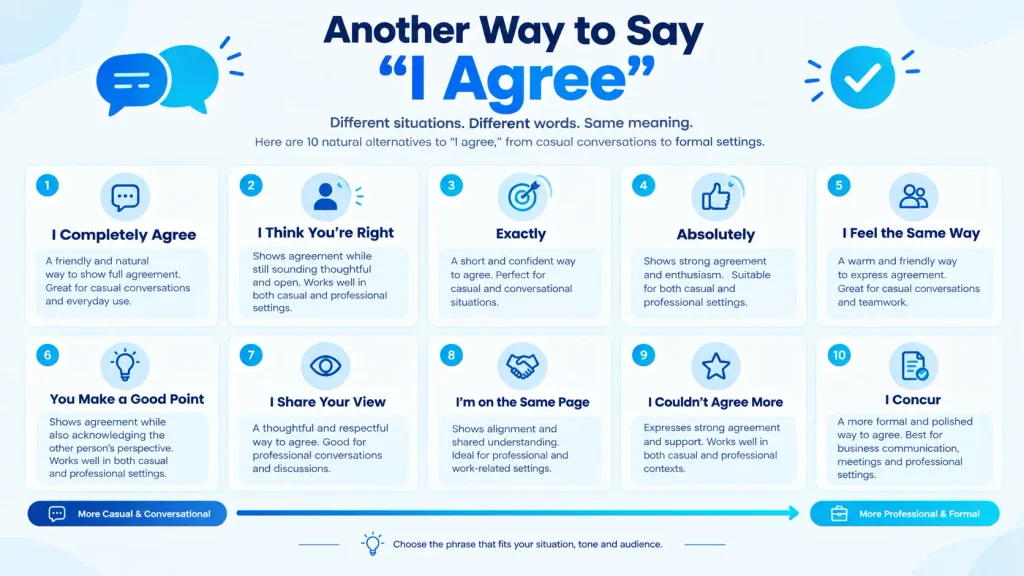
I Completely Agree
Meaning
“I completely agree” means that you fully support or accept what another person has said. It communicates stronger agreement than the simple “I agree.”
Best For
This phrase works well in professional conversations, meetings, discussions, and situations where you want to make your agreement clear.
Formality
4/5 — Professional
Example 1
“I completely agree that we need to improve communication between the two departments.”
Example 2
“You said that preparation is the key to a successful presentation. I completely agree.”
Quick Tip
Use this expression when you agree with the person’s overall point. If you agree with only one part of an argument, choose a more specific phrase such as “You make a good point.”
I Think You’re Right
Meaning
“I think you’re right” means that you believe the other person’s opinion, observation, or conclusion is correct.
Best For
It is natural in everyday conversations, workplace discussions, and friendly communication.
Formality
3/5 — Neutral
Example 1
“I think you’re right. We should review the proposal before sending it.”
Example 2
“You think the instructions are difficult to follow? I think you’re right.”
Quick Tip
This phrase sounds polite and natural without being overly formal or overly enthusiastic.
Exactly
Meaning
“Exactly” is a short way to show that someone’s statement matches your own thoughts or understanding.
Best For
Use it in casual conversations, meetings, quick responses, and everyday communication.
Formality
3/5 — Neutral
Example 1
“We need to focus on quality instead of rushing the project.”
“Exactly.”
Example 2
“Good communication can prevent many workplace problems.”
“Exactly.”
Quick Tip
“Exactly” works best as a direct response to something someone has just said. It can sound too brief when a detailed explanation is expected.
Absolutely
Meaning
“Absolutely” expresses clear and enthusiastic agreement. It can sound stronger and more positive than simply saying “I agree.”
Best For
It works well in conversations, meetings, workplace discussions, and informal professional communication.
Formality
3/5 — Neutral
Example 1
“Should we confirm the details before we send the email?”
“Absolutely.”
Example 2
“I think every team member should have a chance to contribute.”
“Absolutely.”
Quick Tip
Use “absolutely” when you want your agreement to sound confident and enthusiastic.
I Feel the Same Way
Meaning
“I feel the same way” means that you have the same feelings, thoughts, or opinion as another person.
Best For
This expression is especially natural in personal conversations, friendly discussions, and situations involving feelings or personal experiences.
Formality
2/5 — Casual
Example 1
“I wish we had more time to spend together.”
“I feel the same way.”
Example 2
“I think people should make more time for the things they enjoy.”
“I feel the same way.”
Quick Tip
Choose this phrase when the agreement is personal or emotional. It is less suitable when you need a formal business expression.
You Make a Good Point
Meaning
“You make a good point” means that you recognize a specific idea or argument as reasonable or convincing.
Best For
Use it in discussions, meetings, debates, classroom conversations, and professional communication.
Formality
4/5 — Professional
Example 1
“You make a good point. We should consider the cost before making a final decision.”
Example 2
“You make a good point about giving students more time to revise their work.”
Quick Tip
This phrase does not necessarily mean complete agreement. You can use it to acknowledge one strong part of someone’s argument while still having a different overall opinion.
I Share Your View
Meaning
“I share your view” means that you have the same opinion or perspective as another person.
Best For
It is particularly suitable for professional communication, formal discussions, business writing, and academic contexts.
Formality
5/5 — Formal
Example 1
“I share your view that the proposal needs more supporting evidence.”
Example 2
“After reviewing the results, I share your view on the proposed changes.”
Quick Tip
This is a polished alternative when “I agree” feels too simple or conversational for the situation.
I’m on the Same Page
Meaning
“I’m on the same page” is an informal expression meaning that you have the same understanding, opinion, or plan as another person.
Best For
It is common in workplace conversations, team discussions, project planning, and casual professional communication.
Formality
3/5 — Conversational
Example 1
“Just to make sure we’re on the same page, the deadline is Friday.”
Example 2
“I’m on the same page. Let’s focus on improving the customer experience first.”
Quick Tip
This expression is common in American workplace English, but it is conversational. Avoid it in formal academic writing.
I Couldn’t Agree More
Meaning
“I couldn’t agree more” means that you agree completely or extremely strongly with what someone has said.
Best For
Use it in conversations, workplace discussions, and situations where you want to emphasize strong agreement.
Formality
3/5 — Neutral
Example 1
“Clear communication can prevent many workplace problems.”
“I couldn’t agree more.”
Example 2
“We should make the instructions easier for first-time users.”
“I couldn’t agree more.”
Quick Tip
This expression communicates very strong agreement. Do not use it when you agree with only part of an idea.
I Concur
Meaning
“I concur” is a formal way to say that you agree with someone’s opinion, decision, or conclusion.
Best For
It is appropriate for formal discussions, official communication, professional contexts, and some formal writing.
Formality
5/5 — Formal
Example 1
“I concur with your assessment of the proposed changes.”
Example 2
“After reviewing the evidence, I concur with the committee’s recommendation.”
Quick Tip
Although correct, “I concur” can sound stiff in casual American English. In everyday conversations, “I agree” or “I think you’re right” usually sounds more natural.
Quick Comparison of Ways to Say “I Agree”
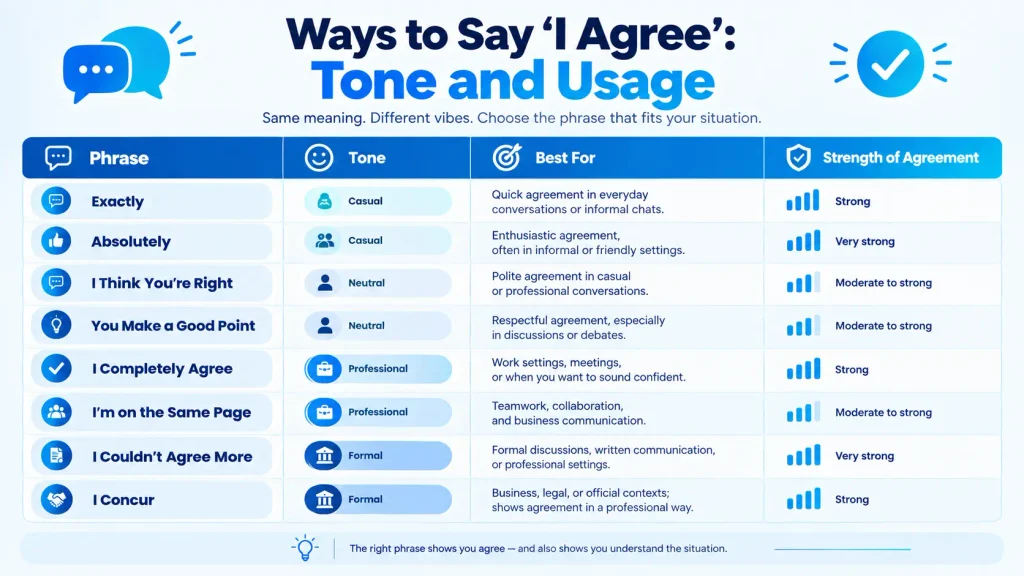
| Alternative | Best Used For | Tone | Formality |
|---|---|---|---|
| I completely agree | Strong agreement | Confident | 4/5 |
| I think you’re right | Everyday agreement | Friendly | 3/5 |
| Exactly | Quick agreement | Direct | 3/5 |
| Absolutely | Strong response | Positive | 3/5 |
| I feel the same way | Personal agreement | Warm | 2/5 |
| You make a good point | Specific argument | Respectful | 4/5 |
| I share your view | Professional agreement | Polished | 5/5 |
| I’m on the same page | Team communication | Conversational | 3/5 |
| I couldn’t agree more | Complete agreement | Emphatic | 3/5 |
| I concur | Formal agreement | Formal | 5/5 |
Which Alternative to “I Agree” Should You Use?
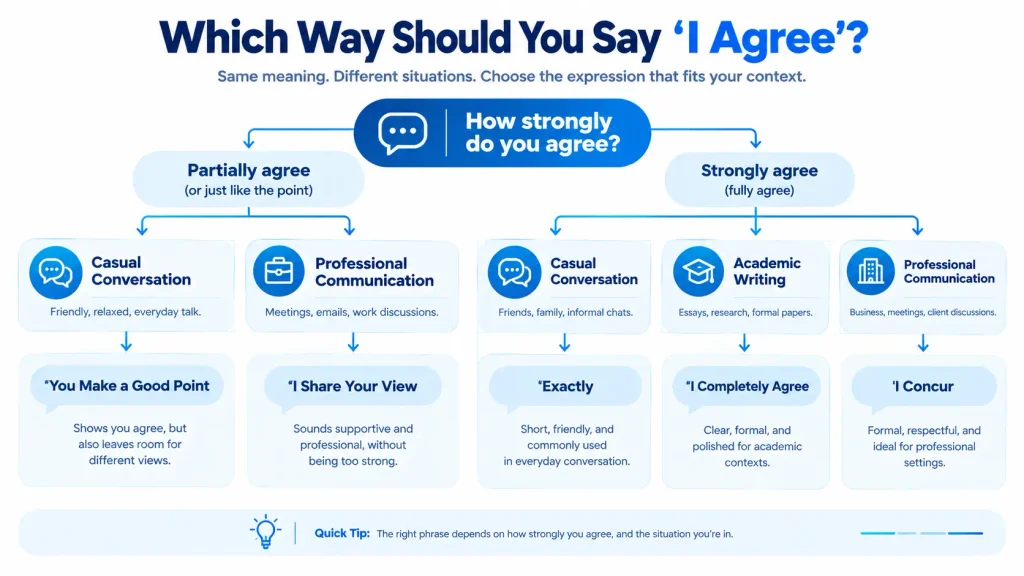
If You’re Talking to a Friend
Use “Exactly,” “Absolutely,” “I think you’re right,” or “I feel the same way.”
These expressions sound natural and relaxed in everyday conversations.
If You’re Talking to a Coworker
Use “I completely agree,” “You make a good point,” “I’m on the same page,” or “I think you’re right.”
These choices are professional without making the conversation unnecessarily formal.
If You’re Writing a Professional Email
Use “I completely agree,” “I share your view,” or “You make a good point.”
For example:
“I share your view that we should review the proposal before moving forward.”
This sounds deliberate and professional while clearly communicating agreement.
If You’re Writing an Academic Paper
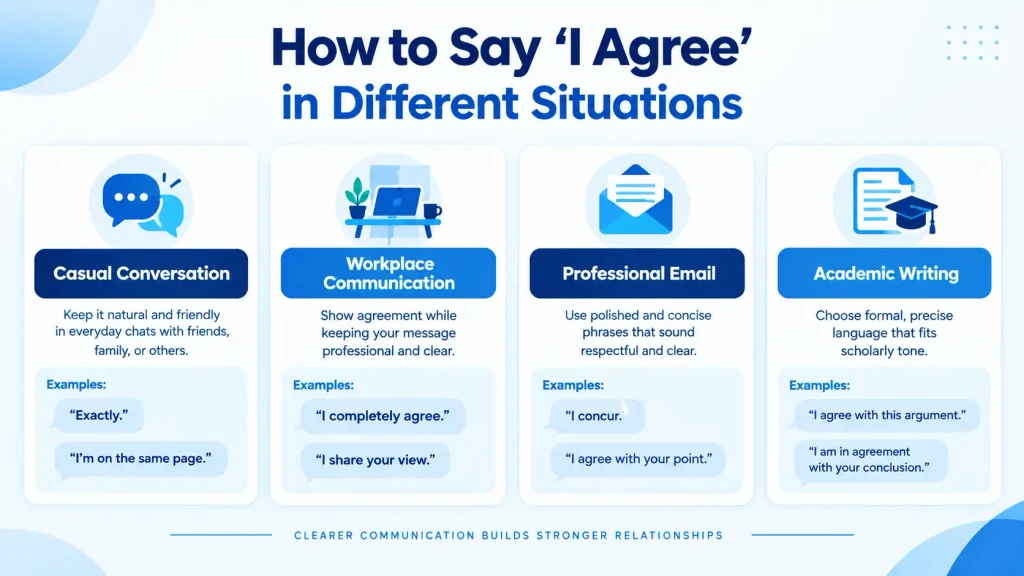
Conversational expressions such as “Exactly” and “I’m on the same page” are usually not appropriate for formal academic writing.
Instead of writing:
“I agree with this idea.”
You can express the relationship between the evidence and the argument more precisely:
“This argument is consistent with the evidence presented above.”
The best wording depends on whether you are presenting your own position, discussing another writer’s argument, or evaluating evidence.
If You Want to Show Strong Agreement
Use “I completely agree,” “I absolutely agree,” or “I couldn’t agree more.”
These expressions make your level of agreement clear.
If You Agree With Only One Part of an Argument
Use “You make a good point,” “I see your point,” or “That’s a fair point.”
These expressions allow you to recognize something valuable in another person’s argument without suggesting that you agree with every part of it.
Common Mistakes When Saying “I Agree”
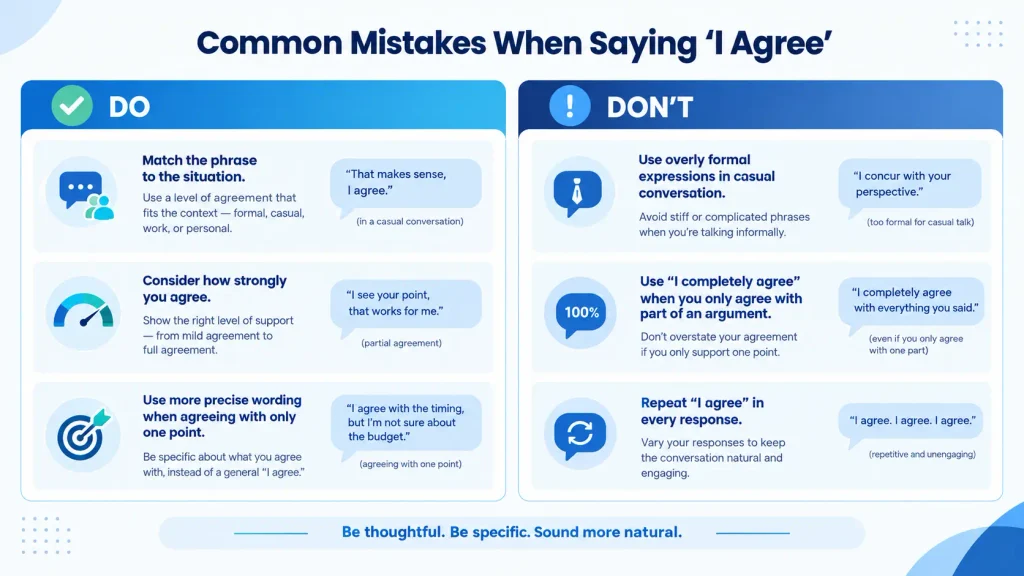
Using “I Couldn’t Agree More” for Partial Agreement
Why It Can Be a Problem
“I couldn’t agree more” communicates complete or very strong agreement. Using it when you only agree with one part of an argument can make your meaning unclear.
Better Approach
Use “You make a good point” or “I see your point” when you want to acknowledge a specific part of someone’s argument.
Using “I Concur” in Casual Conversations
Why It Can Be a Problem
“I concur” is formal and can sound stiff when used between friends or in relaxed conversations.
Better Approach
Use “Exactly,” “Absolutely,” or “I think you’re right” for a more natural conversational tone.
Treating “You Make a Good Point” as Complete Agreement
Why It Can Be a Problem
“You make a good point” recognizes the strength of a particular argument. It does not necessarily mean that you agree with the person’s entire position.
Better Approach
Use “I completely agree” when you genuinely support the person’s overall idea.
Using Casual Expressions in Formal Academic Writing
Why It Can Be a Problem
Expressions such as “I’m on the same page” are conversational and may not fit the tone of an academic paper.
Better Approach
Use precise academic language that explains how your argument relates to the evidence or another position.
Repeating “I Agree” Too Often
Why It Can Be a Problem
Repeating the same expression can make your communication sound repetitive, especially during a longer discussion or in written communication.
Better Approach
Choose alternatives according to the meaning you want to communicate instead of replacing “I agree” with random synonyms.
FAQs About “Another Way to Say I Agree”
What is a professional way to say “I agree”?
Professional alternatives include “I completely agree,” “I share your view,” and “You make a good point.” “I share your view” sounds particularly polished, while “You make a good point” works well when you are agreeing with a specific argument rather than the entire position.
What is a casual way to say “I agree”?
Common casual alternatives include “Exactly,” “Absolutely,” “I think you’re right,” and “I feel the same way.” These expressions work naturally in conversations with friends and familiar coworkers. “Exactly” is especially useful when someone’s statement directly matches your own thoughts.
Is “I concur” the same as “I agree”?
Yes, “I concur” means that you agree, but it has a more formal tone. It can work in formal discussions and professional contexts, but it may sound stiff in casual American English. In everyday situations, “I agree,” “I think you’re right,” or “I completely agree” will usually sound more natural.
Is “I couldn’t agree more” a strong way to say “I agree”?
Yes. “I couldn’t agree more” communicates complete or very strong agreement. It is useful when you want to emphasize that you strongly support what someone has said. Because it expresses a high level of agreement, it should not be used when you agree only partially.
Can I say “Exactly” instead of “I agree”?
Yes. “Exactly” is a natural short response when someone has said something that matches your opinion. For example, if someone says, “We need better communication,” you can respond, “Exactly.” It is conversational and direct, so it may not be appropriate for every formal writing situation.
How can I agree without saying “I agree”?
You can say “I think you’re right,” “Exactly,” “Absolutely,” “You make a good point,” “I share your view,” or “I feel the same way.” Choose the expression based on your intended meaning. For example, “I feel the same way” focuses on shared feelings, while “You make a good point” focuses on a specific argument.
What is a polite way to agree with someone?
“I think you’re right,” “You make a good point,” and “I completely agree” are all polite choices. “You make a good point” is particularly useful when you want to acknowledge someone’s reasoning without making the response sound overly enthusiastic.
What is the best way to say “I agree” in an email?
For a professional email, “I completely agree,” “I share your view,” or “You make a good point” can work well. Use “I completely agree” for full support, “I share your view” for a polished tone, and “You make a good point” when responding to a particular argument.
Conclusion
The best alternative to “I agree” depends on the situation and the strength of your agreement. For casual conversations, “Exactly,” “Absolutely,” and “I think you’re right” are natural choices. For professional communication, “I completely agree,” “You make a good point,” and “I share your view” can sound more polished.
If you want to express complete agreement, “I couldn’t agree more” is a strong option. When you agree with only one part of someone’s argument, “You make a good point” is more precise than saying “I completely agree.”
The key is to match your expression to the tone, relationship, setting, and level of agreement. Choosing the right phrase can make your English sound more natural, clear, and intentional.

Melody Schaefer is the Founder and Editor-in-Chief of FrontiersPost, where she oversees the publication of clear, useful, and thoughtfully researched content for modern readers. Her editorial focus includes language, communication, vocabulary, writing, and practical topics that help readers understand information with greater clarity and confidence.
At FrontiersPost, Melody works with writers and editors to maintain consistent editorial standards, improve content quality, and ensure that published articles are useful, accessible, and easy to understand. She is particularly interested in clear communication and presenting complex or easily confused topics in a straightforward way.
As Editor-in-Chief, she is also responsible for guiding the site’s editorial direction, reviewing content standards, and helping ensure that articles are regularly maintained and improved as information evolves.